
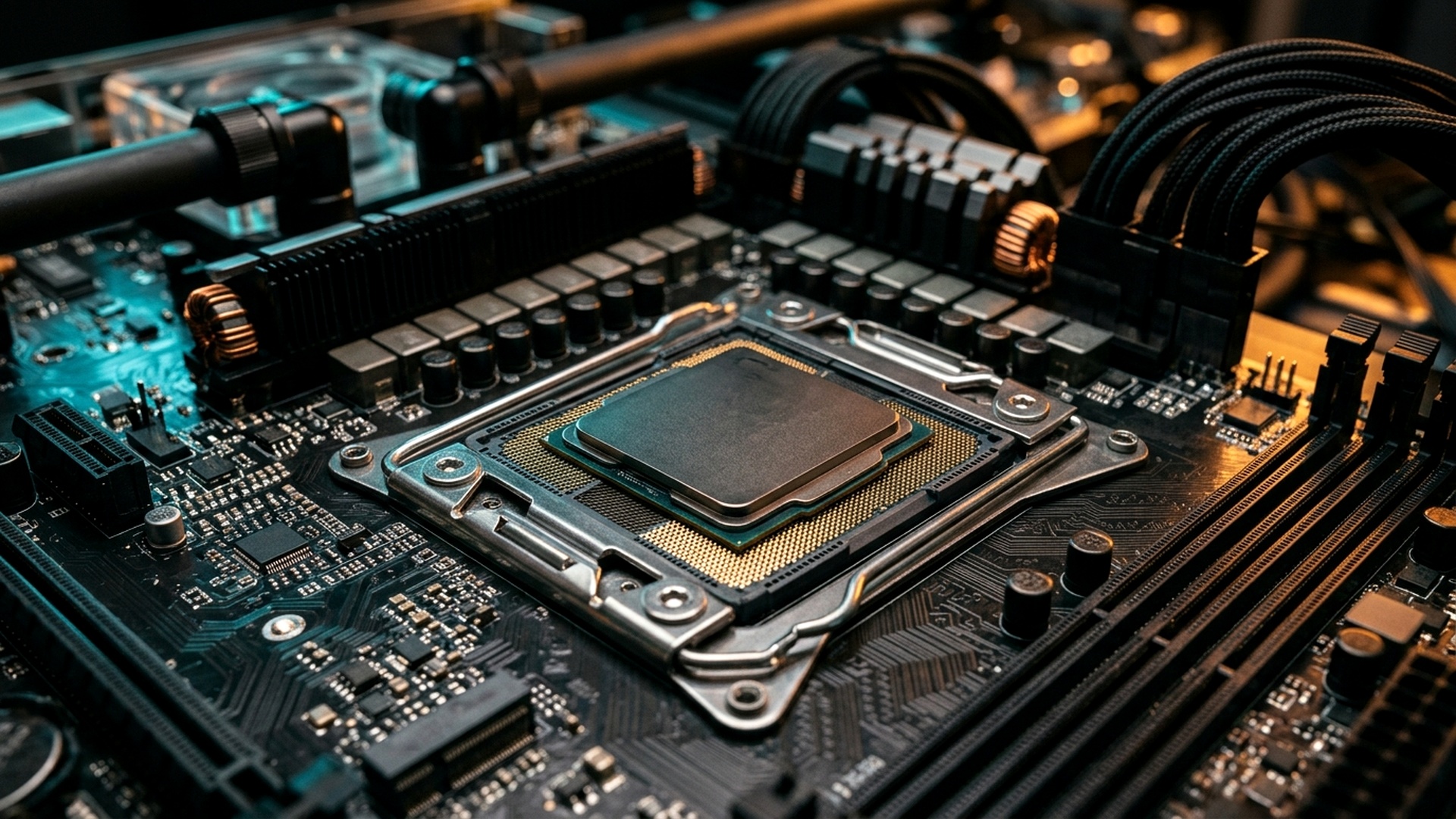
The desktop PC hardware market has been thrown into an unprecedented purchasing frenzy following the retail debut of AMD’s Ryzen 7 9800X3D processor. Widely hailed by hardware testers, competitive esports athletes, and enthusiast benchmarkers as the undisputed king of gaming CPUs, the octa-core Zen 5 powerhouse vanished from digital storefront shelves within seconds of launch. From Amazon and Newegg to physical Micro Center brick-and-mortar retail outlets, inventory allocations were completely wiped out, sparking rampant eBay scalping markups exceeding $250 over the processor’s $479 suggested retail price.
The overwhelming consumer demand is directly attributable to AMD’s engineering triumph with second-generation 3D V-Cache architecture, which completely eliminates the thermal and frequency trade-offs that afflicted earlier X3D generations. When contrasted against Intel’s newly launched Core Ultra 9 285K (Arrow Lake), which exhibited regressions in gaming frame rates despite efficiency improvements, enthusiast builders have converged overwhelmingly on Team Red. Below is our comprehensive retail restock guide, stock tracking methodology, and detailed architectural benchmark analysis.

Architectural Revolution: Why the 9800X3D Crushes Gaming Benchmarks
The secret behind the Ryzen 7 9800X3D’s market dominance lies in a fundamental physical inversion of silicon packaging. In the previous-generation Ryzen 7 7800X3D, the 64MB 3D V-Cache SRAM die was mounted directly atop the primary Core Complex Die (CCD). This stacked arrangement trapped thermal heat inside the CPU cores beneath it, forcing AMD to impose strict voltage limits, modest boost clock frequency caps (5.0 GHz max), and locked multiplier overclocking.
In the 9800X3D, AMD engineers re-engineered the packaging layout, placing the 64MB 3D V-Cache SRAM tile *underneath* the Zen 5 compute die directly adjacent to the motherboard substrate. This places the high-frequency CPU cores in direct physical contact with the integrated copper heat spreader (IHS) and liquid cooling water blocks. The result is a transformative leap in clock speeds: the 9800X3D operates with a 4.7 GHz base clock and boosts up to 5.2 GHz out of the box, with full unlocked BCLK and multiplier overclocking capabilities that allow enthusiasts to comfortably breach 5.5 GHz under standard liquid cooling.
| Processor Spec | AMD Ryzen 7 9800X3D | AMD Ryzen 7 7800X3D | Intel Core Ultra 9 285K |
|---|---|---|---|
| Cores & Threads | 8 Cores / 16 Threads (Zen 5) | 8 Cores / 16 Threads (Zen 4) | 24 Cores (8P + 16E) / 24 Threads |
| Base & Boost Clock | 4.7 GHz / 5.2 GHz (Unlocked) | 4.2 GHz / 5.0 GHz (Locked) | 3.7 GHz / 5.7 GHz Boost |
| Total L3 Cache Pool | 96MB (32MB + 64MB 3D V-Cache) | 96MB (32MB + 64MB 3D V-Cache) | 36MB Smart Cache (No V-Cache) |
| Thermal Design Power (TDP) | 120 Watts | 120 Watts | 125W Base / 250W PL2 Max |
| 1080p Esports Gaming Lead | +14% Faster than 7800X3D | Baseline Reference Standard | -8% Slower than 9800X3D in Games |
| MSRP / Street Scalper Price | $479 MSRP / ($699 – $749 Scalped) | $449 MSRP / ($429 Street) | $589 MSRP / Readily Available |
Real-Time Inventory Tracker: Micro Center, Best Buy & Online Restocks
For PC builders refusing to capitulate to extortionate reseller markups, monitoring verified retailer shipment windows is the only viable path to securing silicon at MSRP:
- Micro Center Physical Stores: Micro Center represents the most reliable inventory source due to strict in-store purchasing policies that mandate physical photo ID and limit purchases to one unit per household every 30 days. Shipments typically arrive on Tuesday and Friday mornings; enthusiasts queuing outside stores by 6:00 AM local time have enjoyed a 60% success rate in claiming voucher wristbands.
- Best Buy Drops: Best Buy releases inventory via its mobile app utilizing geographic queuing verification. Ensure your Best Buy app has biometric Face ID payment enabled to checkout within the 30-second reservation window.
- Newegg Combo Bundles: Newegg frequently sidesteps automated scalper bots by listing 9800X3D processors bundled alongside X870 motherboards or 32GB DDR5 memory kits. While requiring higher upfront capital, buyers can easily return unwanted secondary components or utilize them in fresh builds.
- Discord & Telegram Alert Bots: Join verified hardware monitoring networks (such as NowInStock and Stock-Informers) with push notifications active to receive millisecond stock notifications.
| Retail Storefront | Restock Frequency | Anti-Scalper Protection | Success Probability |
|---|---|---|---|
| Micro Center (In-Store Only) | Bi-Weekly (Tuesdays / Fridays) | Physical ID Voucher Verification | High (For Morning Queuers) |
| Best Buy (Online / App) | Unannounced Wave Drops | SMS Code & App Account Queue | Moderate (Fast Mobile Checkout) |
| Newegg (Bundles) | Random Daily Drops | Motherboard / RAM Combo Bundles | High (Higher Upfront Spend) |
| Amazon Official Store | Sporadic Flash Batches | Low (Heavy Bot Competition) | Low (Sells Out in Sub-Seconds) |
AM5 Motherboard Compatibility & BIOS Update Prerequisite
If you successfully secure a Ryzen 7 9800X3D, verifying motherboard firmware compatibility before assembling your system is critical. While existing B650, X670, and newer X870 motherboards utilize the identical AM5 socket, the 9800X3D mandates updated AGESA 1.2.0.2a (or newer) BIOS firmware to boot properly.
If purchasing an older B650 motherboard manufactured prior to October 2026, ensure the board features a ‘BIOS Flashback’ button on the rear I/O panel. This permits you to flash the updated firmware using a formatted USB thumb drive without needing an older CPU installed in the socket.
Production Yields: When Will Normal Supply Return?
Supply chain reports from TSMC indicate that packaging capacity for AMD’s inverted 3D V-Cache is ramping aggressively heading into early 2027. Market analysts predict that retail availability will stabilize by mid-January 2027 as post-holiday shipping backlogs clear, at which point consumers will be able to purchase the processor freely at its standard $479 MSRP.


For more PC hardware buying advice and performance guides, explore our Black Friday PC Gaming Hardware Deals Guide or review our PS5 Pro vs Custom PC Hardware Comparison.
Memory Scaling: DDR5 6000 vs 8000 MT/s on X870 Motherboards
A frequent inquiry among prospective Ryzen 7 9800X3D purchasers is whether high-frequency DDR5 memory kits provide noticeable performance dividends. Because the processor houses an immense 96MB of ultra-fast L3 cache, the vast majority of gaming instruction sets are resolved directly on-die, dramatically reducing the CPU’s dependency on external system memory latency.
Rigorous memory benchmarks across modern titles confirm that pairing the 9800X3D with a standard 32GB (2x16GB) DDR5-6000 CL30 EXPO kit running at a 1:1 memory controller (UCLK:MCLK) ratio delivers virtually identical gaming performance (within 1.5%) to expensive DDR5-8000 kits operating at a decoupled 1:2 ratio. For gamers assembling a new build, reallocating the $100 price premium from extreme memory kits into a faster graphics card or high-capacity NVMe drive yields significantly superior system-wide performance per dollar.
| Memory Configuration | Memory Clock & Timings | UCLK:MCLK Ratio | Average Gaming FPS (1080p) | Price-to-Performance Value |
|---|---|---|---|---|
| DDR5-6000 CL30 (EXPO) | 3000 MHz / 30-36-36-76 | 1:1 Synchronous (3000 MHz) | 284.5 FPS (Sweet Spot) | Exceptional ($85 – $95 Kit) |
| DDR5-6400 CL32 (EXPO) | 3200 MHz / 32-38-38-80 | 1:1 Synchronous (Requires Silicon Luck) | 286.2 FPS (+0.6% Delta) | Good (Higher Memory Controller Stress) |
| DDR5-8000 CL38 (XMP) | 4000 MHz / 38-48-48-96 | 1:2 Decoupled (2000 MHz UCLK) | 285.8 FPS (+0.4% Delta) | Poor ($180+ Premium Cost) |
Cooling Requirements: Air Cooling vs 360mm Liquid AIOs
Thanks to the inverted packaging design that places CPU cores right beneath the heat spreader, cooling the Ryzen 7 9800X3D is remarkably straightforward compared to power-hungry Intel counterparts. Under full all-core Cinebench R23 rendering loads, the 9800X3D draws approximately 115 to 125 watts of electrical power, operating at a tame 72 to 76 degrees Celsius under a budget $35 dual-tower air cooler like the Thermalright Peerless Assassin 120 SE.
When equipped with a 280mm or 360mm liquid AIO cooler, temperatures drop into the low-60s during intensive gaming marathons, leaving ample thermal headroom for enthusiasts pursuing Precision Boost Overdrive (PBO) frequency offsets of +200 MHz and Curve Optimizer undervolts of -20 to -30 mV.

Consumer Protection: How to Spot Reseller Scalper Scams
With demand at fever pitch, unscrupulous third-party sellers on digital marketplaces have deployed fake listings. Always verify that listings on Amazon or Newegg specify ‘Ships from and Sold by Amazon.com’ or ‘Sold by Newegg’ rather than unverified third-party storefronts charging $750. In addition, beware of counterfeit marketplace listings offering processors without integrated retail packaging or serial numbers.
Platform Longevity: AMD’s AM5 Socket Commitment Through 2027+
A decisive advantage tipping consumers toward the Ryzen 7 9800X3D over Intel’s LGA 1851 platform is socket longevity. While Intel’s Core Ultra 200S motherboards are projected to support only a single processor refresh, AMD has publicly reaffirmed that the AM5 socket platform will receive continuous CPU architecture updates through 2027 and beyond. Investing in a quality X870 or B650 motherboard today guarantees a clear, multi-year upgrade trajectory without requiring complete motherboard or cooling system replacements.
Related posts:
 Singapore & APAC Pro Hardware Playbook: Sub-5ms Fiber Routing to Singapore AWS Servers, Marvel Rivals 120 FPS UE5 Settings & 360Hz QD-OLED Monitor Calibration
 Black Friday 2026 PC Hardware & Monitor Deals: Buy QHD 180Hz IPS Displays Now or Wait for Nov 27 GPU Cuts?
 Monster Hunter Wilds PC System Requirements & Best Optimization Guide: VRAM Memory Leak Fixes & Stable 60 FPS
 Black Friday 2026 PC Gaming Hardware Deals: RTX 4070 Ti Super vs RX 7900 XT, OLED Monitors & NVMe Sales
