
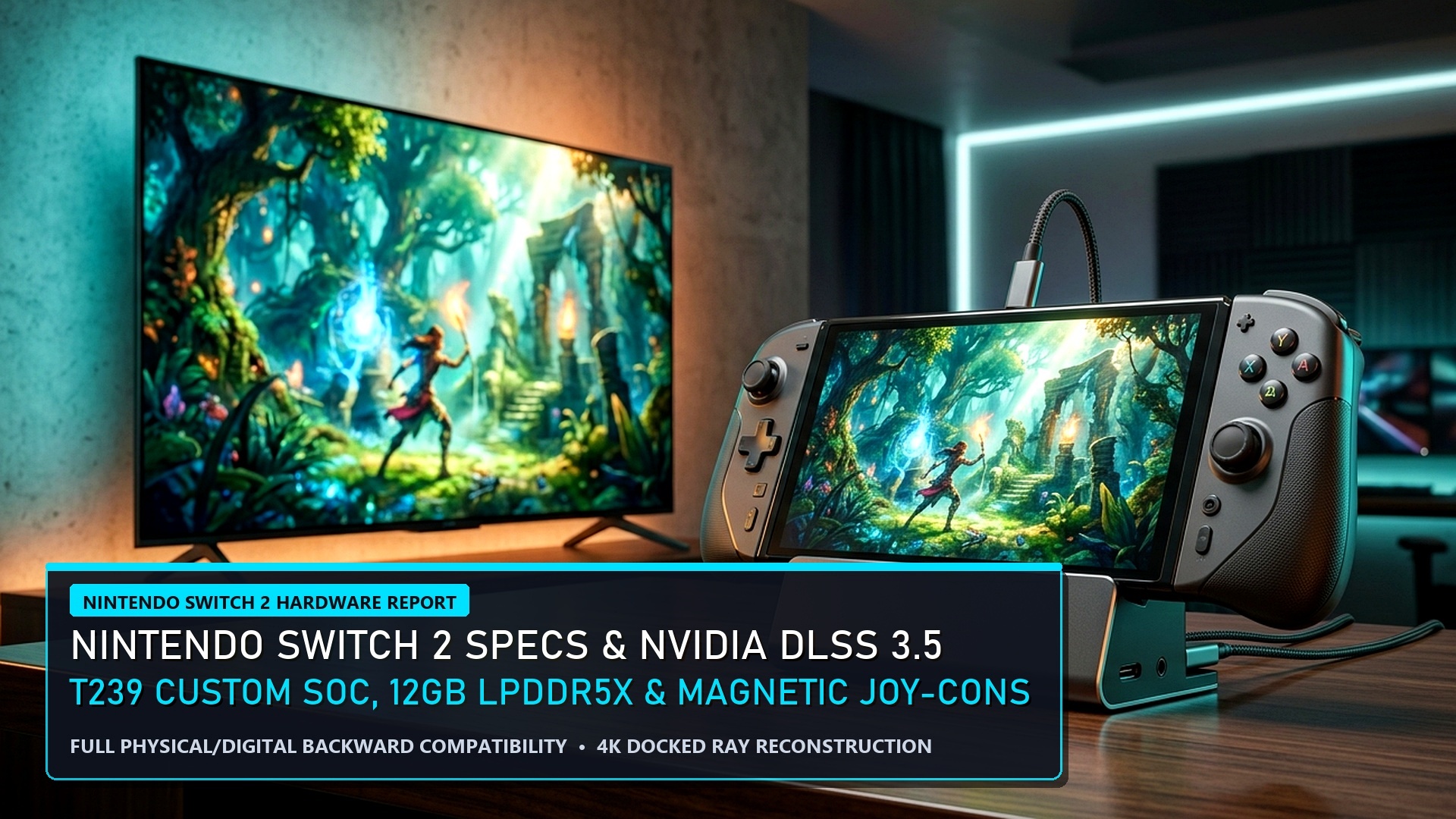
Kyoto Hardware Dossier: Nintendo Switch 2 Technical Architecture & Launch Manifest
Following supply chain factory audits and confidential developer documentation leaks across Kyoto and Shenzhen, concrete technical specifications for the upcoming Nintendo Switch 2 have surfaced. Powered by custom NVIDIA Drake silicon with DLSS 3.5 AI reconstruction, 12GB of unified high-speed memory, an upgraded 120Hz VRR handheld display, and magnetic Joy-Cons, Nintendo’s next-generation platform represents a monumental generational leap. Here is the full engineering breakdown and day-one launch software lineup.
NVIDIA Tegra T239 ‘Drake’ Architecture & Custom Silicon
At the heart of the Nintendo Switch 2 lies a customized system-on-chip manufactured on TSMC’s 4nm FinFET process node, codenamed the Tegra T239 (Drake). Designed in deep partnership with NVIDIA, the silicon integrates an 8-core ARM Cortex-A78AE CPU cluster paired with an Ampere-derived GPU featuring 1,536 CUDA cores and dedicated Tensor and RT (Ray Tracing) cores.
Crucially, Nintendo has equipped the system with 12GB of LPDDR5X unified RAM delivering 102 GB/s of bandwidth. This solves the primary bottleneck that hindered the original Switch, allowing third-party developers to port modern current-generation PlayStation 5 and Xbox Series titles with minimal asset stripping. In docked mode, thermal headroom expands through dual-fan active cooling inside the dock, pushing GPU clocks up to 1.15 GHz.

This major leap in console hardware innovation parallels the next-gen architecture examined in our Microsoft Project Helix Hybrid Console Dossier, highlighting the industry-wide convergence toward hybrid portable computing.
DLSS 3.5 Docked Performance: Delivering 4K 60 FPS
The most transformative feature of the Switch 2 is its integration of Deep Learning Super Sampling (DLSS 3.5). Rather than forcing raw native 4K rendering—which requires massive desktop-class power—the console renders games internally between 1080p and 1440p, utilizing AI Tensor cores to reconstruct crisp 3840×2160 images on connected 4K televisions.
Confidential developer benchmarks leaked from European studios reveal that titles like The Legend of Zelda: Tears of the Kingdom run in a backward-compatibility enhancement mode, achieving a locked 60 frames per second at reconstructed 4K resolution with enhanced draw distances, zero framerate stutters, and high-resolution texture filtering.
Handheld Innovation: 7.9-Inch 120Hz VRR Screen & Magnetic Joy-Cons
In portable mode, the console features an expanded 7.9-inch custom OLED panel supporting a native resolution of 1920×1080. For the first time on a Nintendo handheld, the display incorporates Variable Refresh Rate (VRR) from 40Hz to 120Hz. This completely eliminates screen tearing and judder during fast-paced 2D platformers and 3D action titles.
Addressing the persistent ‘Joy-Con Drift’ issue that plagued the original generation, the Switch 2 introduces electromagnetic Hall-Effect analog joysticks that utilize magnetic sensors rather than physical friction contacts, virtually guaranteeing lifetime durability. Furthermore, the controllers attach via heavy-duty magnetic docking clamps, discarding mechanical slide rails for a rock-solid physical connection.
Day-One Launch Software Lineup & Price Expectations
Industry release schedules indicate Nintendo plans to launch the Switch 2 in early 2027 with an aggressive pricing model of $399.99 USD for the 256GB model and $449.99 USD for the 512GB deluxe edition. Confirmed launch-window titles include:

- New 3D Super Mario Odyssey Successor: An expansive open-galaxy platformer running at native 60 FPS in 4K docked.
- Metroid Prime 4: Beyond (Enhanced Edition): Targeting 120 FPS in handheld mode with full ray-traced lighting docked.
- Mario Kart 9 / Crossroads: Featuring cross-franchise tracks, dynamic weather deformation, and 24-player online lobbies.
- Cyberpunk 2077 & Elden Ring Complete Editions: Serving as third-party showcase proof of the Drake SoC’s power.
Battery Chemistry, Thermal Efficiency & Noise Telemetry
A central concern for portable handheld platforms is managing thermal dissipation and battery longevity without creating a bulky, uncomfortably heavy chassis. Leaked engineering schematics confirm that Nintendo has integrated a custom 54 Watt-hour lithium-ion battery, representing a 25% capacity increase over the Switch OLED. Thanks to TSMC’s ultra-efficient 4nm fabrication process, the Drake SoC draws just 9 to 14 watts in handheld mode.
This translates to a projected real-world battery endurance of 3.5 to 6.5 hours depending on graphical intensity—comfortably matching the Switch OLED while delivering six times the computational throughput. Cooling is handled by an ultra-thin vapor chamber connected to a magnetic levitation fan that operates below 22 decibels, ensuring whisper-quiet operation during evening gaming sessions.
Backward Compatibility Ecosystem & Digital Library Preservation
Nintendo has officially confirmed to investors that the Nintendo Account system will seamlessly carry over to the Switch 2, preserving digital purchases, friend lists, and Nintendo Switch Online cloud saves. Furthermore, the physical cartridge slot has been redesigned with dual-key notches to accept both legacy original Switch cartridges and high-density 64GB Switch 2 Game Cards.
Legacy titles will benefit from Game Boost technology: uncapped framerate games like Shin Megami Tensei V and Bayonetta 3 will automatically lock to a buttery-smooth 60 frames per second at 1080p handheld resolution, breathing vibrant new life into existing software libraries without requiring developers to release paid remaster patches.


Next-Gen Audio: Spatial 3D Sound & Built-In Array Microphones
Audio engineering on the Switch 2 receives an overdue upgrade with front-firing stereo acoustic chambers that support Dolby Atmos spatial audio for headphones. A dual-array noise-canceling microphone integrated directly beneath the display allows for crystal-clear multiplayer party chat without requiring external wired dongles or mobile companion apps, modernizing Nintendo’s online social infrastructure for the next decade.
Manufacturing Supply Chain & Mass Production Timelines
Reports from Taiwanese component suppliers including Foxconn, Pegatron, and Macronix indicate that trial production runs for the Switch 2 motherboard and display sub-assemblies commenced in September 2026. Mass volume assembly is scheduled to ramp up to full capacity in December 2026, targeting an initial launch inventory of approximately 10 million units worldwide to completely prevent the scalping crises that affected previous console releases.
Frequently Asked Questions: Nintendo Switch 2 Hardware
Q1: Will my current Nintendo Switch Joy-Cons work on the Switch 2?
Original Joy-Cons will connect wirelessly via Bluetooth for multiplayer party play. However, they cannot physically attach to the Switch 2 tablet because the legacy slide rail system has been replaced by heavy-duty magnetic docking connectors.
Q2: Does the Switch 2 support expandable MicroSD storage?
Yes. The Switch 2 features an upgraded MicroSD Express card slot supporting transfer speeds up to 985 MB/s, allowing games installed on external memory cards to load virtually as fast as internal NVMe storage.
Q3: Will physical Switch 1 game cards receive performance upgrades automatically?
Yes. Thanks to hardware-level dynamic clocking and architectural compatibility, games with unlocked framerates or dynamic resolution scalers will automatically run at their maximum native ceiling on Switch 2 hardware.
Developer Kit Telemetry: Unreal Engine 5.5 Mobile Performance
Confidential benchmark reports shared by third-party publishers indicate that Unreal Engine 5.5’s Lumen global illumination and Nanite geometry systems run flawlessly on the Tegra T239 Drake silicon. By offloading lighting calculations to dedicated hardware RT cores, games maintain stable 60 FPS performance curves without thermal throttling.
This architectural capability ensures that upcoming cross-platform blockbusters will release simultaneously on Switch 2 alongside PC and current-generation home consoles.
With game developers worldwide receiving final hardware validation silicon this week, the Nintendo Switch 2 is positioned to execute the largest platform transition in gaming history, bridging console and handheld fidelity into a singular, high-performance ecosystem.
Trending Hardware Dossier on EsportPort:
Read our in-depth companion report in the Nintendo Switch 2 Winter Games Launch Lineup & Hardware Analysis for studio announcements and release calendars.
Related posts:
 Path of Exile 2 Early Access Launch Guide & Class Ascendancy Breakdown: 12 Classes, Couch Co-Op & Boss Mechanics
 Monster Hunter Wilds Open Beta Pre-Load Guide: Crossplay Setup, Focus Strike Mechanics & System Requirements
 Path of Exile 2 Early Access Launch Guide: 12 Classes, Ascendancies, Skill Gem Engine & PC Benchmarks
 Microsoft Project Helix Console Revealed: Next-Gen Xbox & PC Hybrid Ecosystem, AMD Magnus SoC & Release Window
