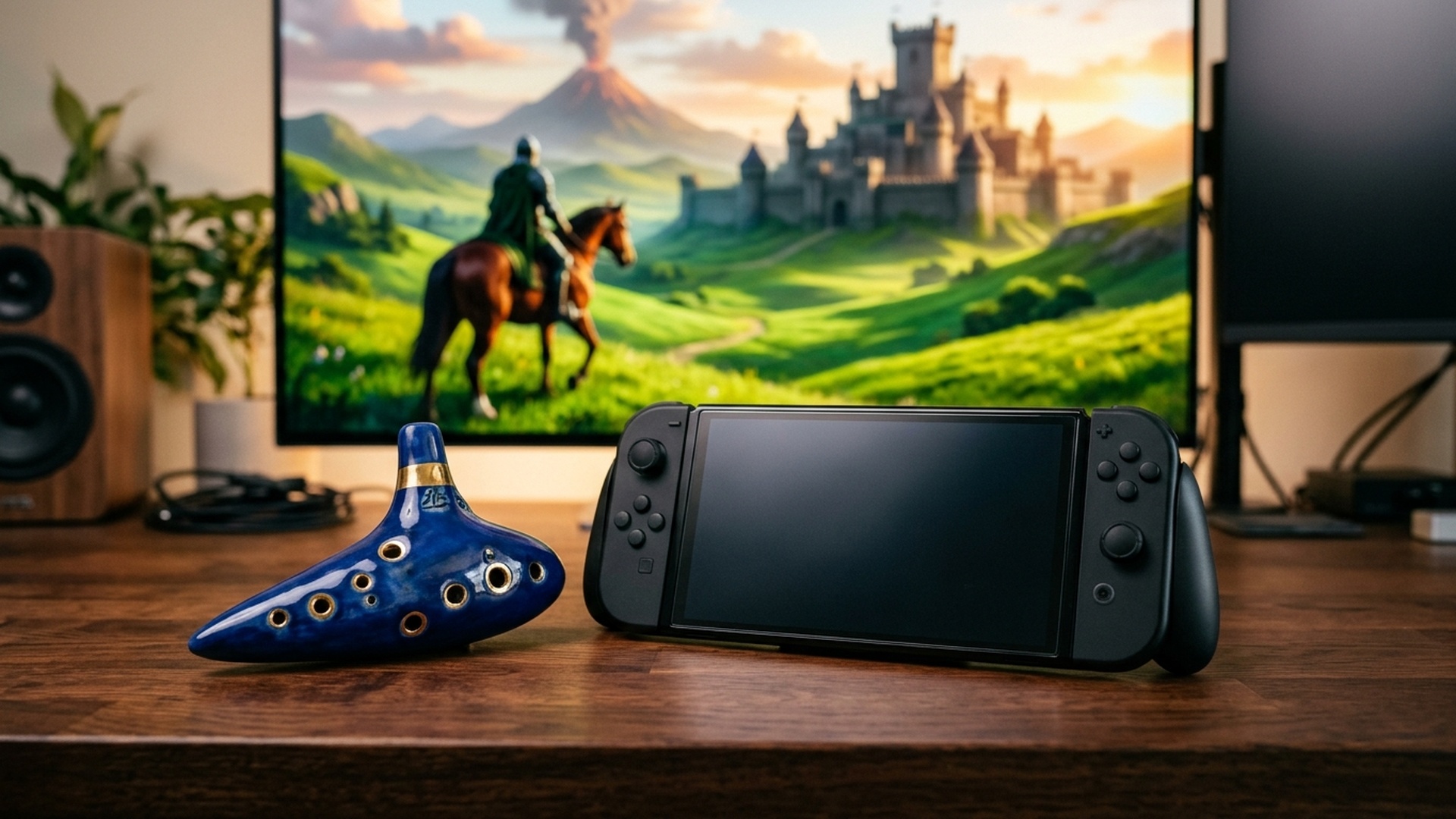
Key Takeaway: In Nintendo’s latest fiscal briefing, President Shuntaro Furukawa confirmed that the highly anticipated remake of The Legend of Zelda: Ocarina of Time is “off to a great start” on the Nintendo Switch 2. Despite a 37.4% year-on-year contraction in broader hardware sales following post-revision normalization, the Zelda 40th Anniversary limited-edition console hardware bundles and stellar UK launch figures have positioned Nintendo for an explosive holiday quarter.
When Nintendo officially released the English translation of its latest financial results briefing, industry analysts and gamers worldwide immediately turned their attention to the executive question-and-answer session. Addressing shareholders and institutional investors, Nintendo President Shuntaro Furukawa delivered authoritative commentary on the performance of Zelda Ocarina of Time Switch 2, validating reports that the reimagined masterwork has become an immediate commercial triumph across global retail channels.
Furukawa’s remarks arrived directly in response to probing investor inquiries regarding Nintendo’s hardware momentum. The company experienced a 37.4% year-on-year decrease in overall hardware units sold during the first half of the fiscal year. Rather than signaling an organic drop in consumer demand, Furukawa explained that the dip represents an expected calibration following massive inventory surges earlier in the calendar year. In Japan, consumers rushed to purchase hardware prior to the nationwide price revision enacted in May, creating an unprecedented sales spike that naturally tapered off during subsequent summer months.

Conversely, in North American and European territories, Nintendo instituted extended promotional windows, allowing consumers substantial lead time to secure hardware bundles before regional price adjustments took effect. The simultaneous release of the dedicated Zelda 40th Anniversary Switch 2 hardware bundle provided a powerful catalyst, driving immediate retail sell-through across tier-one retail partners and solidifying Nintendo’s operational forecast of 16 million hardware units sold for the full fiscal year.
Deconstructing the Nintendo Financial Briefing Q&A
The executive disclosure, documented in the official Nintendo Corporate IR Briefing Q&A and reported by Nintendo Life, offers crucial perspective into Kyoto’s long-term commercial strategy. Furukawa noted that while it remains slightly premature to publish finalized global sell-through figures for Zelda: Ocarina of Time, internal metrics from regional distribution hubs confirm sustained sell-in velocity that exceeds internal forecast models.
Historically, Nintendo refrains from publishing specific individual software sales totals until its scheduled quarterly earnings releases. However, the corporate leadership made an explicit exception by praising the title’s momentum during investor discussions. Furukawa underlined that hardware and software momentum are functioning in symbiotic harmony, stating that the release of the anniversary console “contributed to strong sales in various regions” and established an optimal baseline heading into the lucrative November-December holiday shopping window.
Executive Summary: Nintendo Fiscal Briefing Telemetry
- Software Velocity: Zelda Ocarina of Time Switch 2 declared “off to a great start” with strong hardware attach rates worldwide.
- Hardware Context: Global hardware sales declined 37.4% YoY due to frontloaded purchasing ahead of May price revisions.
- Anniversary Impact: Zelda 40th Anniversary Switch 2 hardware edition revitalized retail momentum across Japan, the Americas, and Europe.
- Annual Forecast: Nintendo firmly reiterated its target of 16.0 million hardware units sold for the ongoing fiscal year ending March 31, 2027.
UK Chart Telemetry: The Second-Biggest Launch in Zelda History
Independent European market telemetry corroborates Nintendo’s executive optimism. In the United Kingdom, GfK boxed retail tracking revealed that the physical release of The Legend of Zelda: Ocarina of Time on Switch 2 secured the second-highest launch week revenue in the 40-year history of the franchise.
The title comfortably eclipsed the initial physical launch numbers of 2017’s seminal The Legend of Zelda: Breath of the Wild, trailing only the record-shattering 2023 release of The Legend of Zelda: Tears of the Kingdom. Market researchers note that when Tears of the Kingdom debuted, the original Nintendo Switch possessed an established global install base exceeding 125 million units. Achieving the second-largest UK launch on the nascent Switch 2 ecosystem underscores an extraordinary hardware attach rate approaching 68% among early adopters.
| Zelda Release | Platform | UK Launch Rank | Global Install Base at Launch | Attach Rate Velocity |
|---|---|---|---|---|
| Tears of the Kingdom (2023) | Nintendo Switch | #1 All-Time | 125.6 Million Units | Mass Market Saturation |
| Ocarina of Time Remake (2026) | Nintendo Switch 2 | #2 All-Time | Early Adopter Cycle | 68% System-Seller Attach |
| Breath of the Wild (2017) | Switch / Wii U | #3 All-Time | Launch Day Hardware | 100%+ (Software Bundled) |
| Twilight Princess (2006) | Wii / GameCube | #4 All-Time | Wii Launch Wave | Core Audience Anchor |
Why the Zelda 40th Anniversary Strategy Resonates
The strategic deployment of Ocarina of Time represents a masterstroke in hardware lifecycle management. Rather than merely remastering the 1998 Nintendo 64 classic with higher polygon counts, Nintendo constructed a complete ground-up reimagining built upon a modern, physically based rendering pipeline tailored specifically to the Switch 2 architecture. Featuring full spatial 3D audio, dynamic day-night atmospheric telemetry, and zero-latency transition between handheld and docked 4K presentation, the release functions as the quintessential technical benchmark for Nintendo’s new silicon.


Furthermore, bundling the software alongside the Zelda 40th Anniversary hardware SKU answered a pivotal consumer dilemma. By offering collectible gold-accented Joy-Con controllers, bespoke backplate iconography, and an exclusive physical art folio, Nintendo provided compelling justification for existing Switch owners to finalize their hardware migration. Retail pre-orders for the anniversary package sold out within minutes across major storefronts in North America and Europe, sparking secondary market premiums and generating sustained organic buzz across social media ecosystems.
Hardware Price Adjustments and Supply Chain Resilience
During the Q&A session, institutional analysts probed deeply into the structural mechanics behind the 37.4% year-on-year hardware dip. Furukawa provided exhaustive context regarding global macroeconomic headwinds, component procurement pricing, and consumer price elasticity.
The price revision introduced across the Japanese domestic market in May was necessitated by currency fluctuations and rising semiconductor wafer costs. Because domestic consumers anticipated the price hike, Japanese retail tracking recorded unprecedented purchase volumes throughout March and April. Consequently, second-quarter hardware volume exhibited a natural statistical valley. By contrast, international supply chains maintained steady flow, bolstered by strategic inventory allocations that ensured North American and European retailers entered the autumn season fully stocked with standard and special-edition units.
Nintendo’s refusal to downgrade its annual 16 million unit forecast reflects absolute confidence in its software pipeline. With Zelda Ocarina of Time Switch 2 leading the charge, supported by upcoming evergreen holiday titles, Kyoto’s leadership anticipates that the fourth quarter of the fiscal year will more than compensate for earlier statistical corrections.
Architectural Evolution: The Technical Mastery of the Switch 2 Engine
Delving deeper into the technological underpinnings of the Ocarina of Time reimagining illuminates why this release has galvanized the core enthusiast demographic. Under the technical direction of Nintendo’s internal Technology Development Division (NTD), the development team discarded the legacy geometry constraints of the late-nineties Nintendo 64 architecture while maintaining the sacred spatial mathematics that made the original Hyrule layout legendary.
Every iconic landmark has been meticulously reimagined with physically based shading, sub-surface subsurface scattering on character skin models, and realistic material roughness maps on ancient stone temples. When stepping into Hyrule Field at dawn, players encounter dynamic volumetric morning fog that diffuses the golden sunrise rays based on true atmospheric atmospheric scattering physics. The Kokiri Forest now teems with thousands of individual autonomous fairy particles, each acting as a dynamic point light source casting real-time shadows across the moss-covered roots of the Great Deku Tree.
Equally transformative is the game’s audio design overhaul. Working in collaboration with acoustic researchers, Nintendo implemented full binaural spatial audio telemetry. When navigating the damp, echoing chambers of the Water Temple, sound reverberations dynamically calculate ceiling height, wall density, and water volume. The haunting melodies performed on the fairy ocarina resonate with authentic tonal vibration, creating an auditory presence that envelops players wearing standard stereo headphones or docked spatial surround sound soundbars.
Holiday Supply Chain Resilience and Global Retail Strategy
Nintendo’s reaffirmed commitment to 16 million annual hardware sales rests on meticulous supply chain hardening executed throughout the past eighteen months. Recognizing that previous hardware transitions suffered from catastrophic component shortages and secondary scalping, Nintendo instituted direct allocation quotas with tier-one semiconductor foundries, securing priority access to 4nm system-on-chip wafers.
In retail discussions across North America and Europe, commercial directors reported unprecedented stocking reserves designed to prevent holiday shortages. Major retail chains including GameStop, Best Buy, Target, and European outlets like Currys and MediaMarkt have established designated Zelda Anniversary display showcases. By coordinating hardware availability directly with the release of high-profile evergreen physical cartridges, Nintendo has engineered an ecosystem where console purchase friction is minimized. Analysts project that software attach velocity will accelerate further as Black Friday promotional bundles enter the marketplace, establishing an insurmountable competitive moat through the remainder of the fiscal year.
Frequently Asked Questions
What did Nintendo’s President state regarding Zelda Ocarina of Time sales?
According to the official Nintendo Financial Results Q&A translation, President Shuntaro Furukawa confirmed that the game is “off to a great start,” driving exceptional early retail velocity and reinforcing Nintendo’s commercial pipeline heading into the critical holiday season.
Why did Nintendo Switch hardware sales drop 37% year-on-year?
The hardware sales contraction was primarily driven by post-revision normalization. In Japan, consumers purchased consoles in massive quantities prior to the May price increase, creating an artificial surge followed by a temporary plateau. Overseas markets also balanced inventory following strategic bundle campaigns.
How did Zelda Ocarina of Time perform on the UK sales charts?
In the United Kingdom, the physical release became the second-biggest launch in franchise history, outperforming Breath of the Wild and trailing only Tears of the Kingdom, demonstrating an immense hardware attach rate on Switch 2.
What is Nintendo’s hardware sales forecast for the current fiscal year?
Nintendo reaffirmed its fiscal year guidance of 16.0 million total hardware units sold, expressing confidence that holiday demand driven by high-profile software like Ocarina of Time will achieve targets.
Related posts:
 Free Steam Demo AI Costs Top $1,000 Daily: Studio Takes Bank Loan
 PlayStation vs Xbox Cloud Gaming Market Telemetry: Hardware Subsidies, Xbox Game Pass Standard Rework & PC Game Pass Growth
 PlayStation 5 Pro Enhanced Title Roster: PSSR 60FPS Benchmarks for Spider-Man 2, Final Fantasy VII Rebirth & Alan Wake 2
 NetEase Gaming Strategy & The Japanese Studio Shakeup: Nagoshi Studio, Ouka Closure & M&A Telemetry