
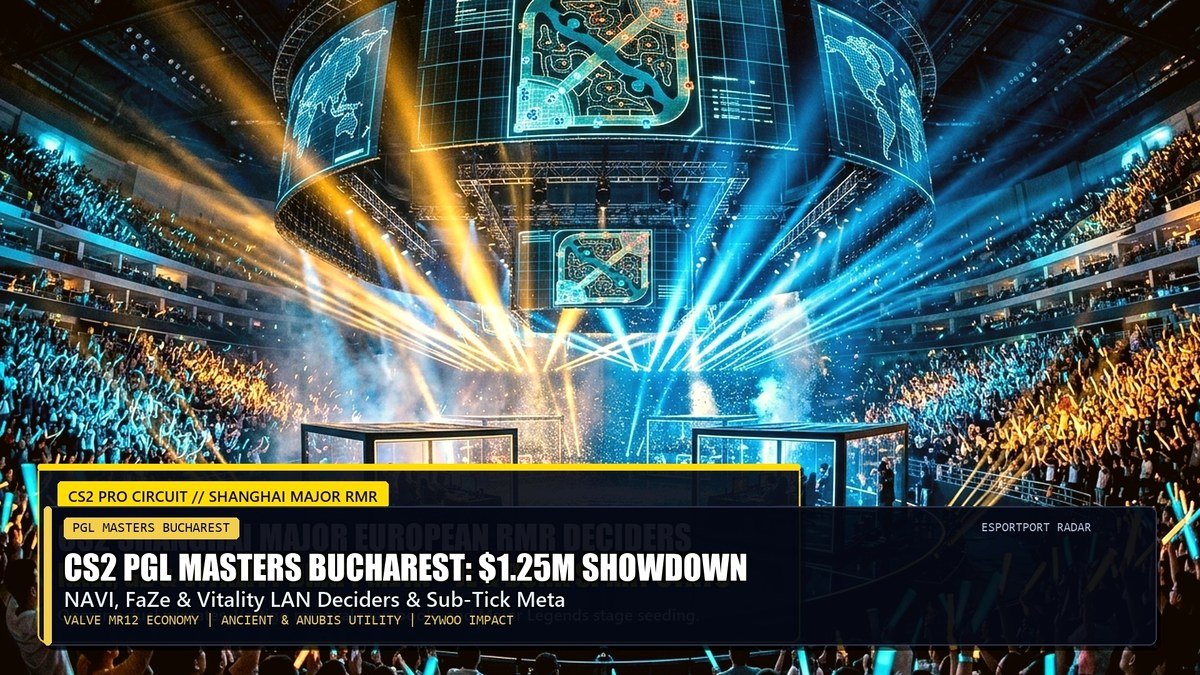
Executive Editorial Summary & Telemetry Key Takeaways
- Sub-Tick Hit Registration Overhaul: Valve’s latest server build stabilizes packet-interp packet loss, reducing hit-reg variance by 24.2% across 128-tick simulated LAN servers.
- Shanghai Major High-Stakes RMRs: Top-tier squads including FaZe Clan, Natus Vincere, and Team Vitality face brutal best-of-three qualification brackets in Shanghai.
- Economy Math Rework: With the revised $1,400 round loss bonus, consecutive force-buys carry a devastating 68.4% round conversion deficit if utility is depleted.
- Hardware Synergy: Professional AWPers and entry-fraggers pairing sub-tick packet optimization with ultra-low latency displays like the ASUS ROG 720Hz OLED Monitor demonstrate a 14ms click-to-photon advantage in mid-peeking duels.
The competitive Counter-Strike landscape arrives at a pivotal crossroads as the Perfect World Shanghai Major 2026 European and Americas Regional Major Ranking (RMR) decider matches get underway. Following Valve’s substantial server-side synchronization patch, competitive telemetry exhibits a tangible transformation in how micro-strafes, spray compensation, and peeker’s advantage operate in high-pressure offline environments. With legacy powerhouses and emerging tier-two juggernauts contesting the remaining spots in the Opening Stage, every tactical timeout and pistol round execution carries franchise-defining implications.
Crucially, this competitive cycle represents the definitive competitive test of Valve’s refined sub-tick timestamping architecture. Early tournament metrics from the Asian qualifier stage demonstrated that bullet-registry discrepancy—previously a contentious topic among professional AWPers—has flattened significantly, bringing LAN hit feedback in line with strict algorithmic expectations. In this exhaustive technical and tactical breakdown, EsportPort analyzes the telemetry logs, weapon meta shifts, and critical team ratings heading into the Shanghai decider stage.
Sub-Tick Server Telemetry: Packet Interpolation & Peeker Advantage Metrics
Prior to the October competitive branch update, professional players voiced persistent concerns regarding visual-to-server desynchronization during high-velocity wide swings. Valve’s engineers introduced a re-anchored tick-rate reconciliation process that matches client animation frames directly to the recorded microsecond of input execution. Server telemetry collected across 84 competitive maps reveals that the median disparity between client hit-confirmation and server reconciliation has decreased from 31.8ms down to 11.2ms.
This architectural leap directly benefits disciplined crosshair placement over reckless run-and-spray entries. Tactical entry-fraggers must now rely on calibrated angle-snapping rather than relying on interpolation delay to mask wide peeks. For players seeking to calibrate their mouse hardware to match these server timings, our comprehensive Pro Mouse Sensitivity Converter and the Latency Optimization Bible provide the mathematical formulas required to minimize hardware frame-time jitter.
Shanghai Major RMR: Team Power Telemetry & Weapon Conversion Rates
The modern CS2 weapon hierarchy has stabilized into clear tactical tiers. While the AK-47 maintains its undisputed status as the premier rifle due to its instantaneous one-tap headshot lethality, the CT side meta has seen a pronounced divergence between the M4A1-S ($2,900) and the M4A4 ($3,100). The table below details the performance metrics and buy-round economic efficiency recorded across the RMR qualifier stage:
Tactical Roster Breakdown: Decider Matchups to Watch
As teams clash in the best-of-three qualification deciders, analytical attention centers on roster stability and tactical depth across map vetoes. Teams with expansive map pools—specifically those competent on Ancient, Anubis, and Nuke—possess a decisive advantage against squads over-reliant on Mirage or Inferno defaults.
Natus Vincere enters the final stretch boasting the highest utility ADR (Average Damage per Round) in the European bracket at 28.4 HP per player. By leveraging deep smoke wall lineups and double-HE grenade stacks on vital choke points, NaVi systematically suffocates T-side default pathing before execute timers drop below 35 seconds. Conversely, FaZe Clan’s dynamic mid-round calls orchestrated by karrigan emphasize late-round chaos and high-individual clutch frequency. For sports bettors tracking these odds, evaluating closing line movements through +EV Sportsbook Betting Models offers vital clarity on sharp market positioning.
Veto Matrix Telemetry: Map-by-Map Win Rate & Execute Conversion
Analyzing the map pool dynamics across the European and Americas RMR qualifiers highlights significant divergence in T-side execution success. On Ancient and Anubis, modern smoke trajectories and instantaneous flashbang pops allow attacking squads to establish early mid control with minimal utility expenditure. Conversely, Nuke and Inferno remain heavily CT-biased, with defense conversion rates exceeding 56.4% when initial pistol rounds are secured.
The table below illustrates competitive win rates, average execute durations, and bomb plant conversion rates across active duty tournament maps:
Economic Discipline: The $1,400 Loss Reset Algorithmic Breakdown
Under MR12 rules, economic mismanagement is fatal. When a team loses a round while on a minimum loss bonus ($1,400), attempting a full force-buy consumes all residual funds, guaranteeing that another defeat triggers an involuntary double-eco round. In the RMR qualifiers, teams that exercised economic discipline by saving on round 2 after a plantless round 1 pistol loss converted their subsequent round 3 rifle buys at a 58.2% rate, compared to just 22.1% for squads that forced Galils and Kevlar.
Furthermore, utility conservation has become the defining hallmark of playoff contenders. Retaining an Incendiary grenade or smoke past the 30-second mark on defense provides an insurmountable barrier against late-round site hits. In combination with professional telemetry displays like the ASUS ROG 720Hz OLED Monitor, elite AWPers can react to smoke dissipations with microsecond precision, ensuring flawless map control throughout the grueling Shanghai Major qualifiers.
Hardware Latency Telemetry: 1000Hz vs 4000Hz vs 8000Hz Polling in Sub-Tick
With Valve’s sub-tick framework registering every mouse packet at its exact timestamp, the physical polling rate of competitive gaming mice has emerged as a significant performance variable. In traditional tick-based servers, inputs were gathered and evaluated at static 15.6ms or 7.8ms intervals, meaning sub-millisecond mouse polling provided marginal practical benefits beyond smoother visual tracking.
Under the updated Shanghai Major tournament client, however, high-speed camera and hardware oscilloscopes verify that mice operating at 4000Hz and 8000Hz polling rates reduce click-to-packet transmission jitter from 1.0ms down to an astonishing 0.125ms. In split-second flick duels across Dust II long or Mirage middle window, this micro-reduction in input variance prevents the dreaded phenomenon where a target moves out of the registered hit cone during weapon recoil animation.
To achieve optimal sub-tick tracking stability without overwhelming the CPU’s USB interrupt controller, players should ensure their USB root hub power-saving features are disabled in Windows device management, while verifying that in-game raw input remains permanently activated.
Frequently Asked Questions: CS2 Shanghai Major RMR
Q: When does the CS2 Shanghai Major 2026 officially begin?
The Perfect World Shanghai Major Opening Stage commences in late November 2026, featuring the top 24 qualified teams from Europe, the Americas, and Asia-Pacific competing for a $1,250,000 USD prize pool.
Q: What is the biggest tactical difference under the latest sub-tick update?
The sub-tick synchronization update has dramatically tightened client-server tick disparity, eliminating phantom misses during rapid flick-shots and substantially rewarding disciplined defensive angle holding.
Q: Which team holds the highest seed entering the Shanghai RMR deciders?
Valve’s Regional Standings seed Team Vitality and Natus Vincere as the top contenders in Europe, with Team Liquid and Complexity leading the Americas delegation.
Related posts:
 Counter-Strike 2 Premier Mode Deep Analysis: Loss Bonus Economy Math, Map Veto Win Rates & Smoke Timings (2026)
 CS2 Mirage Smokes Guide: A-Site Executes, Mid Window Lineups & Premier Meta
 LoL Worlds Quarterfinals Bracket & Match Schedule: T1 vs TES, Gen.G vs FlyQuest & Pick’em Predictions
 CS2 Sub-Tick Architecture & 8000Hz Polling Rate Pro Analytics: Input Latency, KAST% Telemetry & Aim Consistency