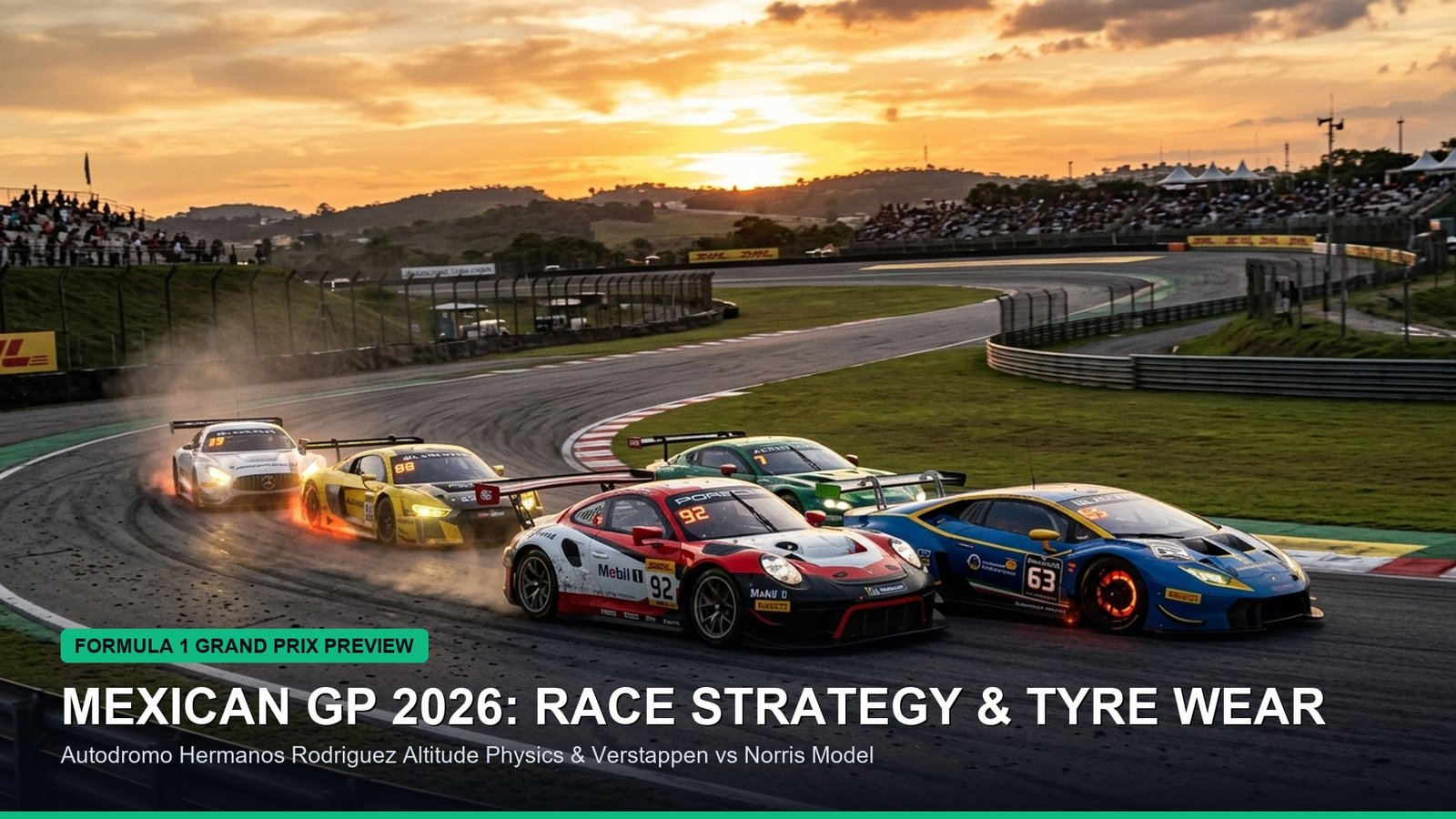
The 2026 FIA Formula One World Championship heads to the vibrant Autódromo Hermanos Rodríguez for the Mexican Grand Prix, setting the stage for a heart-stopping high-altitude strategy battle between Max Verstappen, Lando Norris, and Charles Leclerc. Situated an astonishing 2,285 meters above sea level in Mexico City, this historic circuit forces engineers into extreme cooling compromises while stripping aerodynamic wings of nearly 25% of their downforce. In this comprehensive technical race preview, we unpack Pirelli tyre compound allocations, expected one-stop vs two-stop undercut models, altitude-adjusted engine telemetry, and verified live broadcast schedules across all major timezones.
Mexican Grand Prix 2026: Circuit Blueprint & Race Day Specs
- Circuit: Autódromo Hermanos Rodríguez, Mexico City, Mexico
- Race Start Time: 01:30 AM IST (Monday early morning) | 20:00 GMT / 15:00 Local Track Time / 16:00 ET
- Race Distance: 71 Laps | 305.354 km total distance | 4.304 km lap length
- Pirelli Compound Selection: C3 (Hard – White), C4 (Medium – Yellow), C5 (Soft – Red)
- Altitude Challenge: 2,285 meters (Thin air reduces air density by ~22%, cutting downforce & cooling efficiency)
- Official Live Broadcast: F1 TV Pro (Global), Sky Sports F1 (UK), ESPN / ESPN+ (USA), FanCode (India)
In this guide
- 1. High-Altitude Physics: Thin Air, Turbo Boost & Brake Thermal Limits
- 2. Championship Clash: Norris vs Verstappen In Turn 1 Braking Zone
- 3. Pirelli Tyre Degradation & Pit Stop Strategy Windows
- 4. Team Top Speed, Downforce & Fuel Flow Benchmarks
- 5. The Peraltada & Foro Sol Stadium Section Demands
- 6. Frequently Asked Questions (FAQ)
1. High-Altitude Physics: Thin Air, Turbo Boost & Brake Thermal Limits
Racing in Mexico City presents mechanical challenges unlike any other venue on the Formula One calendar. Because the air density at 2,285 meters altitude is approximately 22% lower than at sea level, aerodynamic drag is dramatically reduced. Teams bolt on maximum-downforce wing packages—similar to setups seen in Monaco or Hungary—yet the cars generate effective aerodynamic load equivalent to Monza. This allows cars to exceed 355 km/h on the 1.2-kilometer main straight while demanding extreme driver precision in slow, mechanical corners.
Mechanically, the thin atmosphere severely impairs cooling systems. Brake ducts, sidepod radiators, and power unit cooling louvres must be opened to their widest limits. Carbon brake discs can easily spike above 1,000°C when decelerating into Turn 1 from 350 km/h, forcing drivers into heavy lift-and-coast sequences during multi-car traffic. Furthermore, the single turbocharger must spin at significantly higher RPMs to pump sufficient oxygen into the 1.6-liter internal combustion engine, testing the reliability limits of Honda RBPT, Mercedes-AMG, and Ferrari power units.
2. Championship Clash: Norris vs Verstappen In Turn 1 Braking Zone
The 890-meter run from the starting grid to the heavy braking zone of Turn 1 is the longest drag race in modern Formula One. Historically, starting from pole position in Mexico is a mixed blessing. The lead car acts as an aerodynamic punch through the thin air, allowing cars starting in second and third on the grid to exploit a colossal slipstream. Lando Norris and McLaren have demonstrated blistering qualifying pace, but Max Verstappen’s aggressive spatial awareness into the tight right-hander of Turn 1 will test track limits and race craft to the extreme.
Ferrari and Charles Leclerc also present a major wild card. The SF-26 package has excelled on street-style slow corners and kerb-riding traction, making the stadium section through the Foro Sol baseball arena a decisive sector for Scuderia pace. If Ferrari can preserve the delicate C4 Medium tyre during the opening 20 laps, Leclerc and Carlos Sainz possess the straight-line velocity to mount an undercut assault on the leaders.
Keep reading on EsportPort
3. Pirelli Tyre Degradation & Pit Stop Strategy Windows
Pirelli has brought the softest trio in its range (C3 Hard, C4 Medium, C5 Soft) to Mexico. Below is the computer-modeled race strategy timeline for the 71-lap Grand Prix:
4. Team Top Speed, Downforce & Fuel Flow Benchmarks
Tracking telemetry data through the speed trap and braking zones illustrates how high downforce setups behave at high altitude:
5. The Peraltada & Foro Sol Stadium Section Demands
The iconic final sector directs cars through the legendary Foro Sol baseball stadium. Surrounded by tens of thousands of passionate fans, drivers must navigate a slow, rhythmic complex of 90-degree corners before accelerating onto the straight. Rear tyre traction out of Turn 16 dictates top speed along the entire 1.2-kilometer front straight. Drivers who overheat their rear tyres in the stadium complex will leave themselves defenseless against DRS overtakes into Turn 1.
Official Broadcast & Streaming Channels:
- Global: Stream full onboard cameras, team radios, and live timing on F1 TV Pro.
- United Kingdom: Complete race buildup on Sky Sports F1 and NOW TV starting at 18:30 GMT.
- United States: Live telecast on ESPN and streaming via ESPN+ with kickoff at 4:00 PM ET / 1:00 PM PT.
- India & Subcontinent: Live streaming exclusively on the FanCode App & Website with race start scheduled for 01:30 AM IST (Monday early morning).
6. Frequently Asked Questions (FAQ)
Why do F1 cars reach such high top speeds in Mexico despite maximum wings?
Because the air is 22% thinner at 2,285 meters altitude, there are fewer air molecules to create aerodynamic drag. Even with massive Monaco-spec wings installed, the air resistance is equivalent to Monza, allowing cars to exceed 355 km/h on the long straight.
How many pit stops are expected in the 2026 Mexican Grand Prix?
A one-stop strategy is the consensus fastest route. Drivers typically start on the C4 Yellow Medium tyre for 20–24 laps before swapping to the durable C3 White Hard tyre to reach the checkered flag at Lap 71.
What is the exact start time of the race in Indian Standard Time (IST)?
The 2026 Mexican Grand Prix starts at 01:30 AM IST on Monday, October 26 (Sunday night/Monday morning in India). FanCode’s live broadcast stream begins at 01:00 AM IST.