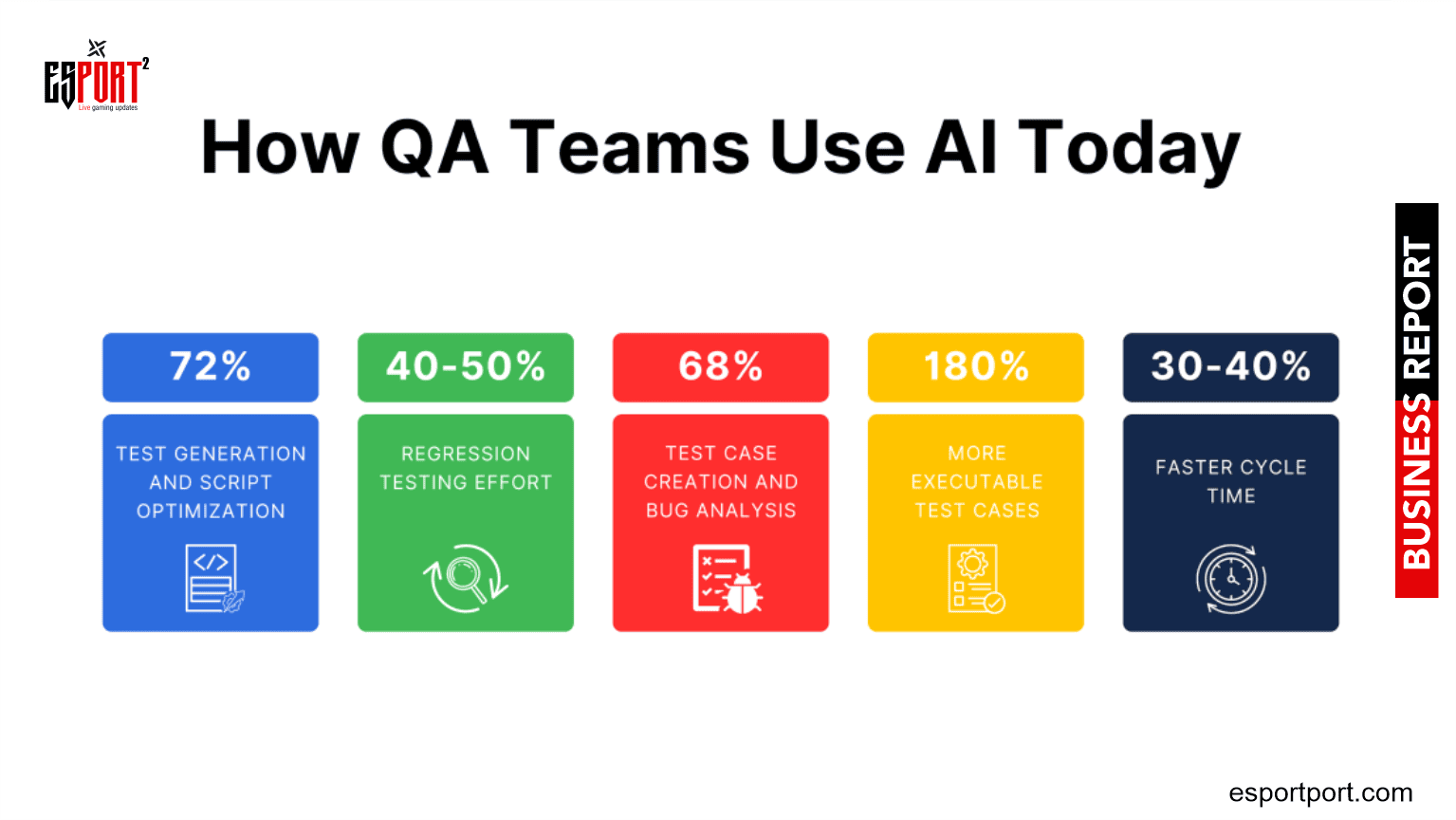
The AAA gaming industry is currently navigating a brutal financial transition. With modern titles routinely exceeding $300 Million in development costs and requiring over half a decade to produce, publishers are desperately searching for avenues to cut operational bloat. For decades, Quality Assurance (QA) departments have operated through sheer brute force—deploying armies of manual testers to repetitively grind against walls, sequence-break quests, and document collision errors.
However, as we analyze the development pipelines of 2026, the integration of Artificial Intelligence (AI) game testers is fundamentally tearing down this traditional infrastructure.
Today, the EsportPort industry desk is exploring how AI is completely transforming the QA sector. We will analyze the immediate cost-cutting implications, the replacement of manual labor, and the necessary evolution of human testers into highly-paid “Quality Engineers.”
Part I: The Brute Force of AI Automation
To understand why major studios are actively pivoting to AI testing, you must understand the sheer inefficiency of human regression testing.
When a developer alters a single line of code regarding lighting in a specific room, it can unintentionally break the physical collision detection on the other side of the map. Traditionally, a human QA tester would have to manually walk an avatar across the entire map, bumping into every single object to ensure the collision physics remained intact. This process takes hundreds of human hours.
The Machine Learning Advantage
In 2026, AI bots are designed to execute these tasks at superhuman speeds. Utilizing machine learning algorithms, AI testers can be programmed to autonomously sprint into every single pixel of a 3D environment simultaneously. They do not need sleep, they do not suffer from fatigue, and they instantly generate highly detailed telemetry reports identifying exactly which line of code caused the player to fall through the floor.
By automating “regression testing” and basic collision mapping, studios are saving millions of dollars in hourly wages and drastically shortening the certification pipeline required by Sony and Microsoft before a game can launch.
Part II: The Shrinking QA Department
The harsh reality of this technological leap is that the traditional QA department—which historically served as the primary entry-level stepping stone into the gaming industry—is shrinking rapidly.
During the massive industry layoffs of 2024 and 2025, QA departments sustained some of the heaviest casualties. Publishers realized that they no longer needed a room of 200 contractors testing a game; they needed a server rack running an AI algorithm and a team of 15 senior engineers to analyze the data output.
| QA Task / Metric | Traditional Human QA | AI Automated Tester |
|---|---|---|
| Collision & Boundary Testing | Days to weeks of manual grinding. | Executed in hours via concurrent bot instances. |
| Load / Server Stress Testing | Requires thousands of beta participants. | Simulates 100,000+ unique user connections instantly. |
| “Fun Factor” & Pacing | Essential human psychological feedback. | Completely incapable of subjective emotional analysis. |
Part III: The Evolution into the “Quality Engineer”
While the raw headcount of QA departments is shrinking, the human element is not being entirely eradicated. Instead, it is being forced to evolve. The era of the “Manual Tester” is dying, but the era of the “Quality Engineer” is booming.
Because the AI bots are handling the tedious, repetitive labor (like checking if a door opens correctly), the remaining human staff is now tasked with analyzing complex, subjective variables that a machine cannot understand.
Narrative Logic and the “Fun” Metric
An AI can tell a developer if a boss’s health bar mathematically depletes correctly. However, an AI cannot tell a developer if the boss fight is actually fun to play.
Quality Engineers are now highly specialized analysts who focus on user experience (UX), narrative pacing, and psychological engagement. They test edge-case logic—for example, if a player kills a specific NPC out of sequence, does the storyline still make emotional sense? These high-level, critical-thinking roles command significantly higher salaries than traditional manual testing, shifting QA from an entry-level grind into a respected, senior engineering discipline.
Conclusion: A Necessary Industry Correction
The integration of AI game testers is not an apocalyptic event for game development; it is a necessary correction. In order for the industry to continue producing massive, graphically dense open worlds without bankrupting the studio or forcing developers into brutal “crunch” schedules, automation is mandatory.
While the size of QA teams will continue to shrink, the quality of the games delivered to consumers will theoretically rise, as human engineers are finally freed to focus on what actually matters: making the game incredibly fun to play.
🚨 Elevate Your Industry Intelligence
Join the Debate on EsportPort
Do you think AI testers will actually lead to bug-free game launches, or will they miss massive exploits? Bookmark EsportPort for premium industry analysis, tech breakdowns, and the financial reality of modern game development.