
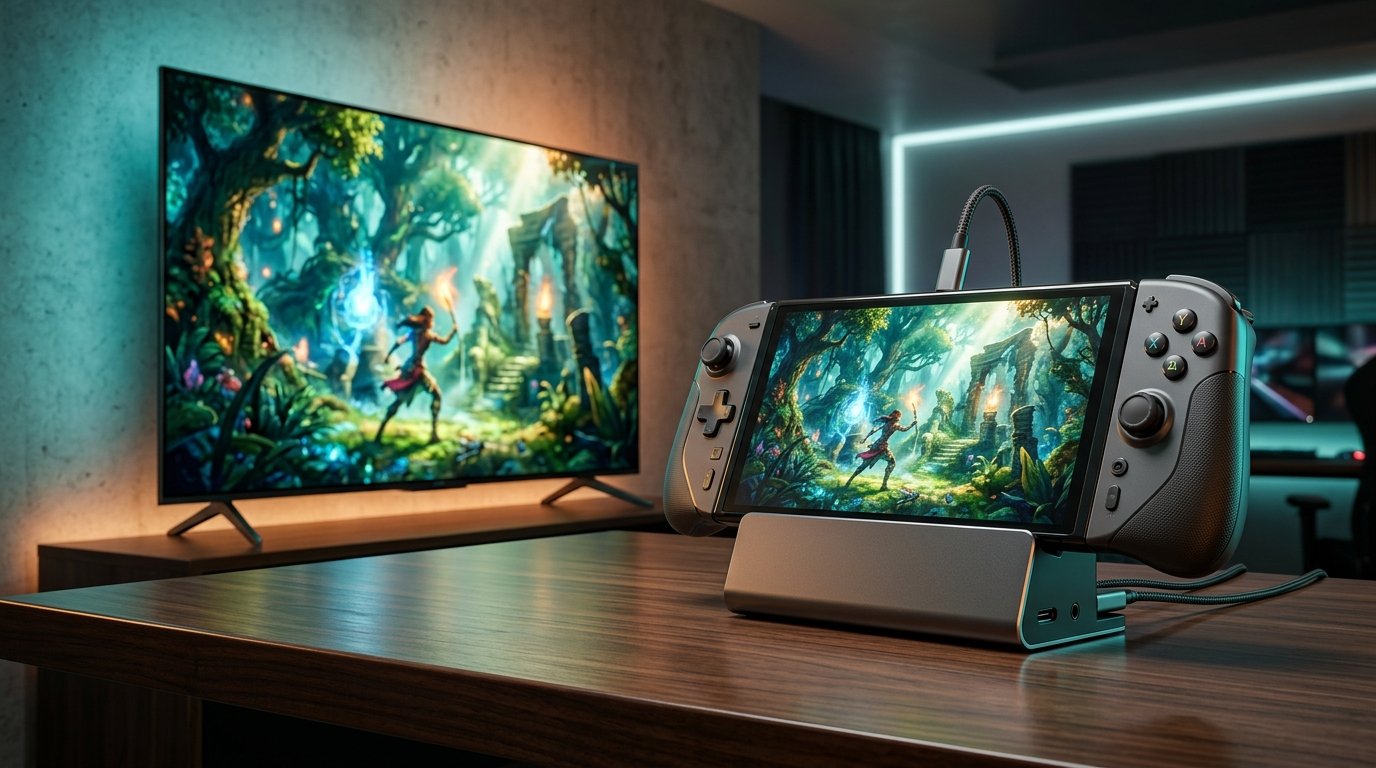
The gaming hardware sphere has reached peak anticipation as manufacturing supply chain leaks, developer documentation, and regulatory filings converge on Nintendo’s highly anticipated successor: the Nintendo Switch 2 (NS2). Slated for an impending formal unveil, the hybrid powerhouse bridges handheld portability with modern home console visual fidelity through custom NVIDIA silicon and AI reconstruction.
Silicon Architecture: The Custom NVIDIA Tegra T239 Processor
At the beating heart of the Switch 2 lies NVIDIA’s custom Tegra T239 chipset, manufactured on an optimized 8nm process node. Featuring an 8-core ARM Cortex-A78C CPU cluster paired with a graphics engine derived from NVIDIA’s Ampere architecture (with select Ada Lovelace efficiency enhancements), the NS2 represents a monumental generational leap over the aging Tegra X1 found in the original 2017 Switch.
Most crucially, the inclusion of dedicated Tensor Cores brings hardware-accelerated DLSS (Deep Learning Super Sampling) to Nintendo hardware for the first time. In docked configurations, this allows internal render targets at 1080p or 1440p to reconstruct into crisp 4K outputs on modern displays without taxing thermal envelopes.
Hardware Specifications Comparison
| Component | Nintendo Switch OLED (2021) | Nintendo Switch 2 (Leaks & Confirmed Specs) |
|---|---|---|
| SoC / Architecture | NVIDIA Tegra X1 (Maxwell, 16nm) | Custom NVIDIA Tegra T239 (Ampere/Ada, 8nm) |
| System Memory (RAM) | 4GB LPDDR4 @ 25.6 GB/s | 12GB LPDDR5X (2x 6GB 7500 MT/s) |
| Internal Storage | 64GB eMMC 5.1 | 256GB UFS 3.1 (High-Speed NVMe-Class) |
| Display Panel | 7.0-inch 720p 60Hz OLED | 8.0-inch 1080p 60Hz/120Hz VRR Display |
| Upscaling Tech | None (Bilinear Hardware Scalar) | NVIDIA DLSS 3.1 & Ray Reconstruction |
| Controllers | Rail-Mounted Mechanical Joy-Cons | Magnetic Locking Joy-Cons with Optical Sensors |
| Backward Compatibility | N/A | Full Physical & Digital Cartridge Support |
Launch Window Software & Backward Compatibility Enhancements
Developer reports confirm that current Nintendo Switch physical cartridges and digital eShop libraries will run natively on Switch 2, with select evergreen titles (including The Legend of Zelda: Tears of the Kingdom and Metroid Prime 4) receiving dedicated “Next-Gen Enhancement Patches” targeting 60 FPS and higher resolution targets.
Upcoming flagship releases scheduled across late 2026 and early 2027—such as Nintendo Switch Sports Resort and Metroid Ravenous—are specifically architected to leverage the hardware’s 12GB memory pool to deliver seamless open worlds with zero loading screens.
To explore how next-generation titles are positioning across platforms, read our complete breakdown of Upcoming Video Game Releases 2026–2027: Release Dates, PC Requirements, Platforms.
Related posts:
 Nintendo Switch 2 Magnetic Joy-Con Patent Breakdown: Optical Mouse Sensor & 100% Game Transfer
 Dragon Age The Veilguard Launch Countdown: PC System Requirements, Preload Dates & Combat Builds
 Super Mario Party Jamboree Launch Weekend: 110+ Minigames, Pro Motion Controls & Switch 2 Teaser
 Twitch Drops Rewards Guide: How to Link Accounts, Claim In-Game Loot & Unlock Evolving Badges