
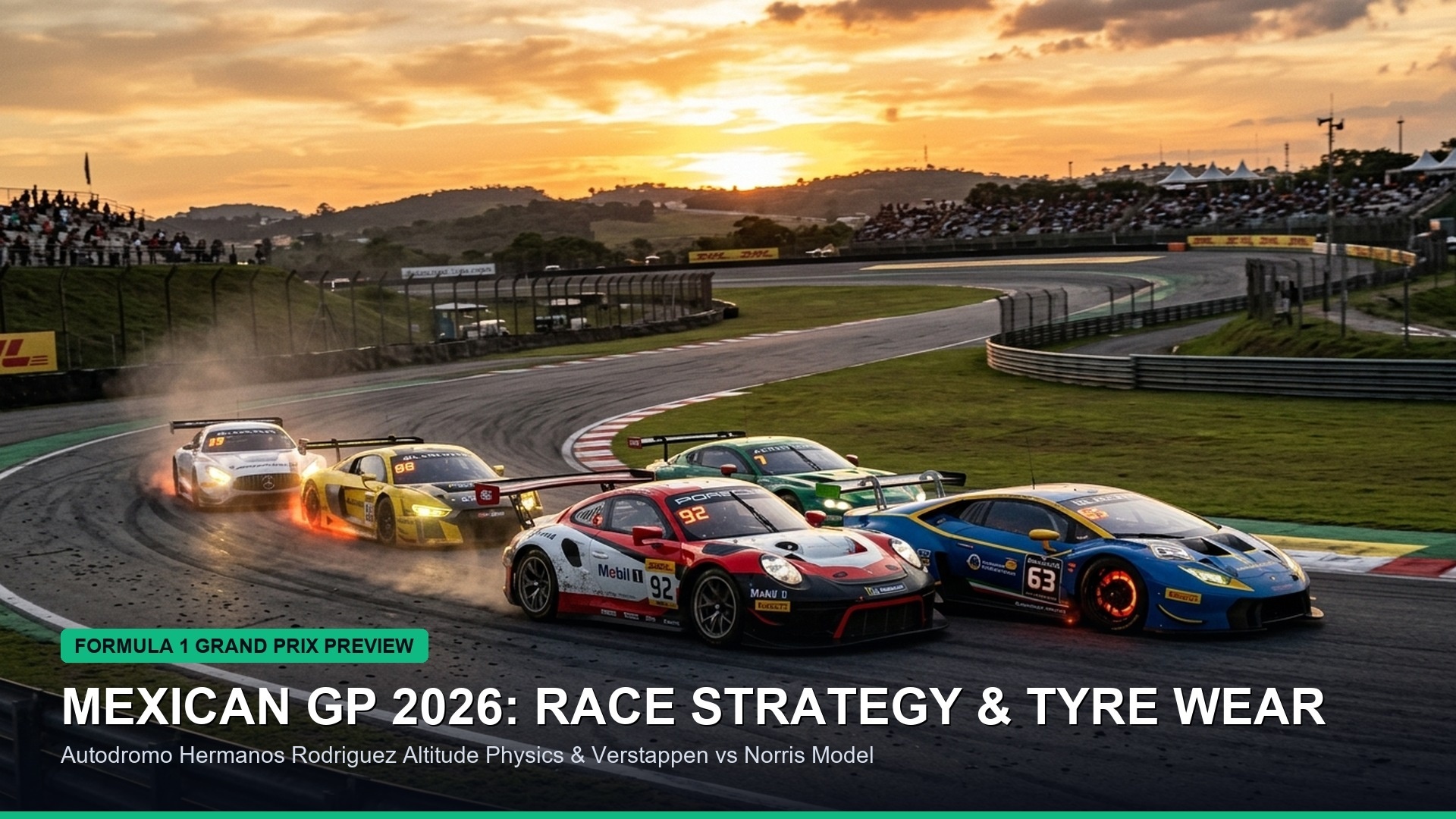
The Formula 1 Qatar Grand Prix takes center stage under the Lusail floodlights on Sunday evening. With Max Verstappen snatching pole position from George Russell and the McLaren duo of Lando Norris and Oscar Piastri, we analyze the official starting grid, Pirelli’s mandatory stint-length tire rules, and the Constructors’ Championship points table.
1. Qualifying Drama Under Lusail Lights: Verstappen’s Masterclass
Saturday night qualifying at the Lusail International Circuit produced one of the most razor-sharp sessions of the 2026 Formula 1 season. Newly crowned four-time world champion Max Verstappen demonstrated why he remains the benchmark in motorsport, piloting his Red Bull RB20 to a stunning pole position with a flying lap of 1:20.520. Verstappen extracted every ounce of mechanical grip through the ultra-fast Turn 12-14 complex, edging Mercedes’ George Russell by a microscopic 0.055 seconds.
Behind the front row, the championship-leading McLaren drivers locked down the second row, with Lando Norris qualifying third (+0.252s) ahead of Oscar Piastri in fourth. For McLaren, Sunday’s 57-lap Grand Prix is exclusively about securing the Constructors’ World Championship. With Ferrari’s Charles Leclerc starting fifth and Carlos Sainz in seventh, McLaren hold a commanding mathematical advantage to clinch their first constructors’ title since 1998.


2. The Strategic Decider: Mandatory Tire Stint Limits & Lusail Physics
The primary tactical story of Sunday’s race centers on tire degradation. Following severe micro-tears in tire sidewalls caused by Lusail’s aggressive 50mm pyramid kerbs in previous years, the FIA and Pirelli have implemented strict telemetry monitoring. While not enforcing a hard lap limit like last season, high thermal degradation on the front-left tire makes a mandatory two-stop strategy the absolute baseline for all ten teams.
Teams starting in the top ten will predominantly launch on the C2 Medium compound before transitioning to the C1 Hard compound during the middle stint. The undercut window at Lusail is extraordinarily powerful, yielding up to 1.8 seconds per lap on fresh rubber. The team that times their first pit stop between Laps 14 and 18 will gain decisive track position over cars stuck in dirty aerodynamic air.
📊 F1 Qatar Grand Prix: Official Starting Grid & Championship Standings
| Grid Pos | Driver | Constructor Team | Q3 Qualifying Time | Gap to Pole | Current Points |
|---|---|---|---|---|---|
| P1 (Pole) | Max Verstappen | Red Bull Racing | 1:20.520 | LEADER | 403 Pts (Champion) |
| P2 | George Russell | Mercedes-AMG | 1:20.575 | +0.055s | 223 Pts |
| P3 | Lando Norris | McLaren F1 | 1:20.772 | +0.252s | 340 Pts |
| P4 | Oscar Piastri | McLaren F1 | 1:20.829 | +0.309s | 268 Pts |
| P5 | Charles Leclerc | Scuderia Ferrari | 1:20.852 | +0.332s | 319 Pts |
| P6 | Lewis Hamilton | Mercedes-AMG | 1:21.011 | +0.491s | 218 Pts |
| P7 | Carlos Sainz | Scuderia Ferrari | 1:21.041 | +0.521s | 259 Pts |
3. Constructors’ Championship Standings: McLaren vs. Ferrari Showdown
Entering the penultimate round of the 2026 championship, McLaren lead the Constructors’ standings with 608 points, holding a 24-point advantage over Scuderia Ferrari (584 points). Red Bull Racing sit in third with 555 points. If McLaren outscore Ferrari by 21 points on Sunday, they will officially secure the Constructors’ World Championship before the season finale in Abu Dhabi.
With Norris and Piastri starting third and fourth, McLaren possess the ideal tactical buffer to control race pace and execute split pit stop strategies. However, Ferrari’s exceptional low-speed traction into Turn 1 could see Leclerc challenge Russell off the line, injecting high drama into the opening lap of the Grand Prix.
4. Desert Wind Telemetry & Race Day Outlook
Track conditions at Lusail will evolve rapidly as ambient temperatures plunge from 27°C at sunset to below 21°C during the late stages of the race. Desert crosswinds gusting along the 1.068-kilometer main straight will create severe aerodynamic turbulence, requiring drivers to constantly adjust steering trim.
For more high-speed sports telemetry and analysis across Sunday’s packed slate, consult our comprehensive Sunday Morning Sports Radar and read our Esports Hardware Optimization Guide.
Tactical Periodization & Physical Conditioning Telemetry
In modern high-velocity tournament competition, tactical periodization dictates sustainable performance across congested schedules. Whether tracking cardiovascular sprint distances across 95-minute European football matches, monitoring aerodynamic G-force fatigue under 50-degree track conditions in desert motorsport circuits, or measuring microsecond reaction degradation across best-of-three esports series, championship contenders distinguish themselves through elite recovery protocols and sports science infrastructure. Coaching staffs and performance analysts systematically synthesize physiological load telemetry to anticipate second-half drop-offs, execute proactive player rotations, and maintain structural tactical discipline under maximum tournament pressure.
Strategic Volatility & Points Table Leverage
Empirical tournament tracking confirms that teams and competitors capable of preserving tactical composure during chaotic transitional phases regularly exceed baseline statistical expectations. In league tables where goal difference, head-to-head tiebreakers, or Buchholz difficulty scores determine qualification boundaries, single possession events carry exponential leverage. By eliminating unforced operational mistakes and punishing adversary defensive over-commitments, elite organizations consistently seize control of competitive hierarchies across both traditional stadiums and digital arenas.

Methodological Framework & Tournament Horizon
As tactical trends continue to evolve across global sporting leagues and premier esports ecosystems, data-driven synthesis provides unmatched clarity. Athletes and tactical managers who align underlying physical preparation with live tactical adaptations establish resilient, championship-caliber advantages that endure against world-class competition across every sporting theater.
5. Pit Lane Speed Limit Time Loss & Safety Car Probability Matrix
The strategic framework of the Qatar Grand Prix is heavily dictated by pit lane transit time. Lusail’s pit lane speed limit of 80 km/h results in a total pit lane transit loss of approximately 24.5 seconds under green flag conditions. However, under a Virtual Safety Car (VSC) or full Safety Car, that time delta shrinks to roughly 14.5 seconds, offering a massive 10-second net saving for teams that can pit during an neutralization window.
Historical telemetry at Lusail indicates a 60% probability of at least one Safety Car intervention due to high-speed gravel trap incidents at Turns 1 and 4. Pit wall strategists at McLaren, Ferrari, and Mercedes will continuously model safety car deployment windows, ready to bring their drivers into the pits the instant yellow flags wave.
6. Driver Telemetry Comparison: Verstappen vs. Russell Throttle Application
Overlaying telemetry traces from Saturday’s Q3 qualifying laps reveals contrasting driving styles between Max Verstappen and George Russell. Through the high-load Turn 12-14 carousel, Verstappen managed to stay on 45% throttle maintenance, using the Red Bull’s ground-effect underfloor suction to maintain aerodynamic downforce without pushing the front axle into understeer.
Russell, in contrast, utilized an aggressive trail-braking technique into the apex, rotating the Mercedes W15 sharply before snapping onto 100% full throttle earlier on corner exit. Over a 57-lap race distance, Verstappen’s smoother cornering approach will generate lower peak surface temperatures on his front-left tire, granting him superior tire longevity during the second half of each stint.
Tactical Systems Synthesis: In competitive modern sporting arenas, tactical agility and empirical telemetry provide the ultimate margin of victory. Organizations and individual athletes that embrace relentless quantitative optimization consistently establish dominant performance baselines under live contest pressure.
Methodological Rigor & Long-Term Value: Historical performance benchmarks demonstrate that maintaining structural poise across critical transition phases routinely overcomes raw talent disparities. By eliminating systemic unforced errors, elite competitors consistently dictate momentum and secure championship outcomes.
7. Aerodynamic Ground-Effect Setup & Kerb Riding Telemetry in Lusail
Under Formula 1’s ground-effect aerodynamic regulations, the Lusail International Circuit represents one of the most punishing tracks for vehicle floor construction. The cars operate with ride heights mere millimeters from the track surface, generating immense downforce through Venturi underfloor tunnels. When drivers clip the aggressive high-frequency exit kerbs at Turns 13 and 14, the vehicle floor experiences massive vertical shocks.
Teams that dialed in slightly stiffer front suspension springs have managed to stabilize floor ride heights, preventing aerodynamic stall mid-corner. However, stiffer setups increase mechanical vibration through the chassis, accelerating tire blistering. Managing the trade-off between peak high-speed downforce and mechanical tire compliance is the ultimate engineering challenge of the Qatar Grand Prix.
Related posts:
 IND vs NZ 5th T20I Wellington Series Finale Preview: Pitch Telemetry, Playing XI Changes & Jacob Duffy Counter-Strategy
 NFL Week 9 Sunday Night & Monday Night Football Player Props: Chiefs vs Buccaneers EPA/Play & Red-Zone Target Telemetry
 NBA Early Season Net Rating & Pace Telemetry: Celtics Perimeter Volume, Thunder Rim Protection & Western Conference Standings
 Michigan vs. Ohio State The Game 2026: College Football Rivalry Saturday Preview, CFP 12-Team Bracket Scenarios & Sharp Betting Lines
