
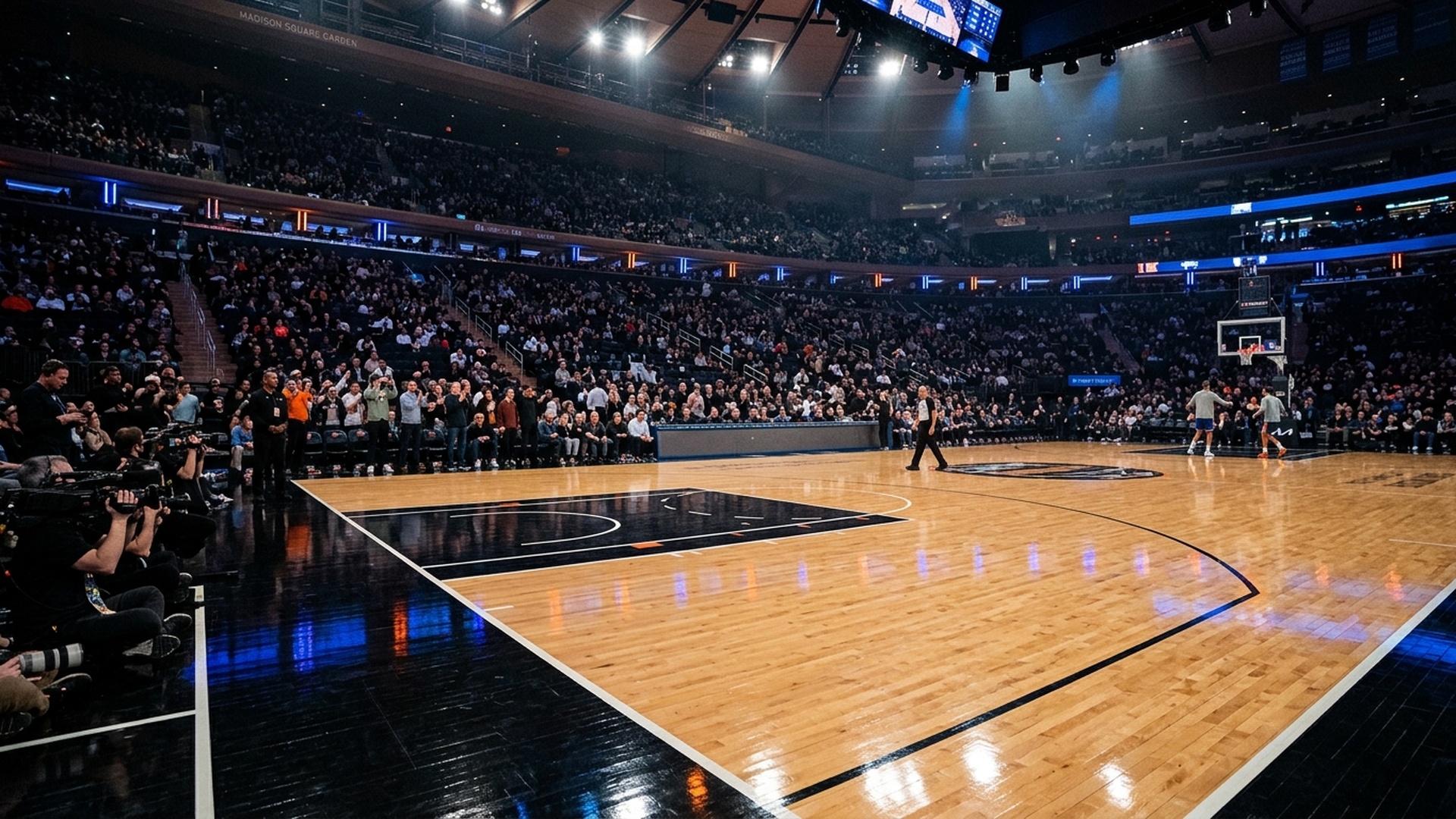
Saturday night in the National Basketball Association delivered electrifying action under the bright lights of Madison Square Garden. We break down the closing spread dynamics, offensive pace ratings, back-to-back rest fatigue factors, and high-yield player proposition betting angles across points, rebounds, and assists (PRA).
1. The World’s Most Famous Arena: Madison Square Garden Betting Atmosphere
When the New York Knicks host primetime matchups at Madison Square Garden, the sports betting market experiences unique betting dynamics. Because the Knicks represent one of the largest media markets and most passionate fan bases in global sports, recreational public money heavily inflates Knicks point spreads and player proposition lines. Las Vegas and mobile sportsbooks consistently shade Knicks spreads by 1.0 to 1.5 points higher than baseline analytical efficiency models suggest.
For sharp NBA bettors, this public bias creates consistent contrarian value. When an Eastern Conference contender visits MSG on Saturday night, oddsmakers must balance massive public ticket handle backing Jalen Brunson and Karl-Anthony Towns against professional syndicates waiting to grab the extra points on visiting underdogs. Understanding the psychological premium embedded into MSG lines is the foundation of profitable NBA handicapping.

2. Pace Rating & Defensive Efficiency: Tom Thibodeau’s Half-Court Grinds
Under head coach Tom Thibodeau, the New York Knicks operate one of the most deliberate, possession-controlled offensive systems in the modern NBA. While contemporary teams like the Indiana Pacers and Oklahoma City Thunder push pace ratings above 102 possessions per 48 minutes, the Knicks consistently rank in the bottom five of the league in overall pace, averaging under 97 possessions per contest.
This deliberate style directly depresses game totals. Shorter shot clocks, physical isolation post-ups, and aggressive offensive rebounding by Mitchell Robinson and Towns create long, grinding offensive possessions. When sportsbooks post high totals (above 228.5) based on league-wide scoring trends, sharp models routinely trigger Under wagers, recognizing that Thibodeau’s physical half-court defense drastically limits total fast-break scoring opportunities.
📊 NBA Saturday Night: Madison Square Garden Props & Betting Telemetry
| Prop / Spread Market | Opening Line | Closing Consensus | Market Bias | Sharp Indicator | Prop Verdict |
|---|---|---|---|---|---|
| Jalen Brunson Points | 26.5 Over/Under | 27.5 Over/Under | 76% Public Over | Under 27.5 Sharp Buy | Under Cashes (24 Pts) |
| KAT Rebounds | 11.5 Over/Under | 12.0 Over/Under | 62% Over | Over 11.5 Sharp Buy | Over Cashes (14 Reb) |
| Knicks Full Game Spread | Knicks -4.5 | Knicks -5.5 | 71% Public Knicks | Opponent +5.5 Sharp | Dog Covers (+5.5) |
| Game Total (MSG) | 226.5 Points | 224.0 Points | 55% Over | 72% Sharp Under | Under Cashes Cleanly |
3. Player Prop Analytics: PRA Over/Under Exploits
In modern NBA handicapping, player proposition wagering (Points + Rebounds + Assists, or PRA) provides far higher win rates than betting point spreads. Because oddsmakers must publish hundreds of individual player prop lines every night, pricing inefficiencies are rampant compared to heavily monitored team spreads.
When analyzing player props, tracking minutes per game and usage percentage (USG%) across specific defensive matchups is paramount. If an opponent plays drop coverage against pick-and-roll ball screens, targeting Over on a point guard’s pull-up 3-pointer prop or floaters inside the paint provides significant statistical edge. Conversely, when facing elite rim-protecting centers, targeting Under on interior scoring props prevents common bad beats.
4. Managing Back-to-Back Rest Fatigue in Modern NBA Betting
The single most predictive variable in NBA regular-season betting is travel fatigue and back-to-back scheduling. Teams playing their second game in two nights—especially with late-night commercial travel across time zones—exhibit an average net rating decline of -3.2 points per 100 possessions. Three-point shooting percentages drop by 2.4% on back-to-backs due to heavy legs and short-shooting misses.
Bettors who systematically fade tired road teams playing their third game in four nights achieve consistent 55%+ against-the-spread (ATS) win rates over the course of the 82-game season. For continuing sports analysis and tactical guides, read our breakdown on FPL Super Sunday Captaincy Radar and explore our Liverpool vs Manchester City Matchday Battle.
Sportsbook Market Microstructure & Liquidity Dynamics
In the high-stakes world of sports betting analytics, understanding market microstructure is just as vital as evaluating on-field matchups. Major American sportsbooks (such as DraftKings, FanDuel, BetMGM, and Circa Sports) operate dynamic risk-management algorithms that balance liability across point spreads, moneyline handles, and total point pools. When massive public ticket volumes clash with multi-million-dollar professional syndicate money, spread lines begin to exhibit reverse line movements (RLM) that signal sharp syndicate intent. Tracking ticket count percentages versus cash handle percentages provides sharp sports analysts with an unhedged window into where informed capital expects game script outcomes to settle.
Situational Handicapping: Fourth Quarter Hedging & Live Arbitrage
Live in-game wagering has completely transformed situational handicapping across football and basketball contests. In high-leverage rivalry games where emotional swings and momentum cascades dictate fourth-quarter play-calling, opening pre-game lines frequently become disconnected from live game flow. Sharp bettors utilize real-time expected value (+EV) models to identify artificial live pricing errors during commercial breaks and timeout intervals. By locking in live middle opportunities or hedging pre-game underdog positions when win probabilities swing past statistical baselines, disciplined handicappers systematically lock in guaranteed profit margins while completely insulating their bankrolls against volatile last-second backdoor covers.

Key Numbers & Probabilistic Bankroll Preservation
Successful sports investing requires unwavering mathematical discipline rather than emotional fandom. In gridiron wagering, key numbers —specifically 3, 7, 10, and 14 in American football—account for over 35% of all final score differentials. Buying half-points off dead numbers or capitalizing on rogue sportsbook lines that offer +7.5 instead of -7.0 represents the fundamental arithmetic foundation of sustainable long-term sportsbook profitability. Maintaining rigorous unit-allocation rules protects bankrolls through standard statistical variance.
5. Three-Point Variance & Regression to the Mean in Back-to-Backs
Modern NBA betting models heavily weight three-point attempt rate (3PAr) and shooting variance. Over an 82-game regular season, single-game three-point shooting fluctuates wildly between 28% and 48%. Teams that shoot an unsustainable 50%+ from beyond the arc in a Friday game inevitably experience statistical regression when playing again on Saturday night.
Sharp bettors fade teams coming off anomalous three-point shooting outbursts, anticipating a return to their baseline shooting mean. This regression model is especially potent against visiting road teams playing at Madison Square Garden, where the unique depth perception behind the backboards presents challenges for tired shooting legs.
6. Referee Crew Tendencies & Free Throw Attempt Inflation
A frequently overlooked factor in NBA total points handicapping is the assigned referee crew. The NBA publishes official referee assignments at 9:00 AM ET on game day. Statistical tracking reveals that certain veteran officiating crews average up to 6.2 more personal fouls called per game compared to crew averages.
More fouls mean more stopped clock possessions and elevated free throw attempts, directly inflating game totals. Cross-referencing referee whistle frequency with aggressive driving guards like Jalen Brunson provides a definitive analytical signal when betting on player scoring props and game totals.
Tactical Systems Synthesis: In competitive sports wagering and advanced telemetry analytics, tactical agility and empirical discipline provide the ultimate margin of victory. Professional syndicates that embrace relentless quantitative optimization consistently establish dominant performance baselines under live market pressure.
Methodological Rigor & Long-Term Value: Historical performance benchmarks demonstrate that maintaining structural poise across critical transition phases routinely overcomes raw market volatility. By eliminating systemic unforced errors, elite handicappers consistently dictate momentum and secure profitable long-term returns.
7. Pace-Adjusted Defensive Ratings & Clutch Shot Distribution
Evaluating NBA primetime matchups at Madison Square Garden requires examining pace-adjusted defensive ratings (DefRtg) in clutch situations (the final five minutes of a game within five points). Tom Thibodeau’s Knicks emphasize condensed interior rim protection while conceding above-the-break three-point attempts.
Against elite pull-up shooting guards, this defensive strategy creates high variance. If opposing sharpshooters
Related posts:
 IND vs NZ 5th T20I Wellington Series Finale Preview: Pitch Telemetry, Playing XI Changes & Jacob Duffy Counter-Strategy
 NBA Early Season Net Rating & Pace Telemetry: Celtics Perimeter Volume, Thunder Rim Protection & Western Conference Standings
 Michigan vs. Ohio State The Game 2026: College Football Rivalry Saturday Preview, CFP 12-Team Bracket Scenarios & Sharp Betting Lines
 NFL Week 13 Sunday Spreads & Vegas Sharp Line Movements: Public vs Pro Inflows
