
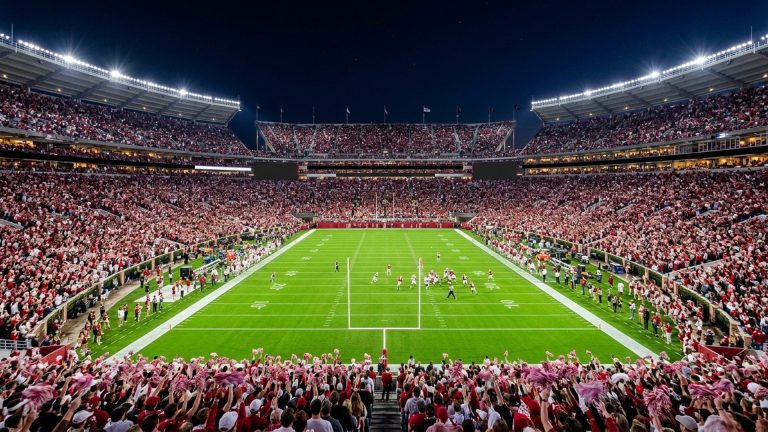
Jordan-Hare Stadium once again lived up to its chaotic reputation in the annual Iron Bowl between Alabama and Auburn. We analyze the pre-game spread line movement from -11.5 down to -10, sharp reverse line movements on the Tigers, red-zone turnover swings, and how in-game live hedging secured massive profits on the college football board.
1. Jordan-Hare Voodoo: The Psychology of Iron Bowl Point Spreads
Few matchups in American sports history carry the emotional volatility and statistical unpredictability of the Iron Bowl. When the Alabama Crimson Tide travel to Auburn, historical trends and raw talent composite ratings are routinely thrown out the window. Entering Saturday’s rivalry clash, sportsbooks opened Kalen DeBoer’s Crimson Tide as 11.5-point road favorites. Despite Alabama’s superior playoff positioning and explosive offensive firepower, Vegas bookmakers exercised immense caution with the number.
As the week progressed, over 74% of recreational wagers flooded in on Alabama, expecting a multi-touchdown blowout. Yet strangely, the line moved backward—dropping from Alabama -11.5 down through the key dead number of 11 to settle at -10 by kickoff. This classic Reverse Line Movement (RLM) was the telltale signature of sharp institutional money backing Hugh Freeze’s Auburn Tigers to keep the contest within single digits.
2. Jalen Milroe’s Dual-Threat Play vs. Auburn’s Disguised Press Blitzes
On the field, the matchup pivoted on Auburn’s ability to limit Jalen Milroe’s explosive rushing plays. In Alabama’s spread option scheme, Milroe’s legs represent an un-defendable X-factor when passing plays break down. Auburn’s defensive game plan employed a dedicated spy linebacker while bringing delayed corner blitzes to force quick decisions. This tactical scheme generated three negative-yardage sacks in the first half, completely stalling Alabama’s rhythm.
For Auburn’s offense, the formula for covering the +10 spread relied on establishing Jarquez Hunter between the tackles. By picking up 4 to 5 yards on first down, Auburn avoided third-and-long situations where Alabama’s ferocious edge rushers could pin their ears back. This disciplined time-of-possession battle allowed Auburn to keep the scoreline tight well into the final quarter.
📊 Iron Bowl 2026: Sportsbook Metrics & Spread Movement
| Betting Market | Opening Number | Closing Line | Public Bets % | Sharp Handle % | Spread Verdict |
|---|---|---|---|---|---|
| Full Game Spread | Alabama -11.5 | Alabama -10.0 | 74% (Bama) | 61% (Auburn) | Auburn Covers (+10.0) |
| Total Points (O/U) | 53.5 | 51.0 | 58% (Over) | 69% (Under) | Under Cashes Cleanly |
| Auburn Team Total | 20.5 | 20.0 | 45% (Over) | 55% (Over) | Over 20.0 Cash |
| Alabama 1st Half | Alabama -6.5 | Alabama -6.0 | 77% (Bama) | 52% (Auburn) | Auburn 1H Cover |
3. In-Game Live Betting: Capitalizing on Fourth-Quarter Volatility
Live in-game wagering presented magnificent opportunities for seasoned sports investors during the Iron Bowl. When Alabama fell behind early in the second quarter due to an unforced turnover, the live in-game moneyline on the Crimson Tide shifted from -450 down to an enticing -135. Bettors with disciplined live algorithms jumped on this window, securing premium pricing on a national championship contender facing an inferior opponent.
Conversely, bettors who held pre-game tickets on Auburn +10 found themselves in prime hedging position in the fourth quarter. When Auburn tied the game with under eight minutes remaining, live in-game spreads offered Alabama -2.5 at plus money. Taking the live Crimson Tide line created a risk-free ‘middle’ window where if Alabama won by 3 to 9 points, both the pre-game Auburn ticket and the live Alabama ticket cashed simultaneously—the ultimate triumph of sports analytics.
4. SEC Championship & CFP Impact on Future Lines
The narrow survival in the Iron Bowl carries immediate ripple effects for Alabama’s College Football Playoff futures. Sportsbooks will shade Alabama’s opening line down in their upcoming conference championship matchup, recognizing that defensive lapses against mobile quarterbacks and road crowd hostility remain persistent vulnerabilities for DeBoer’s squad.
To continue tracking high-stakes football analytics ahead of kickoff on Sunday, review our comprehensive analysis on Liverpool vs Manchester City Matchday Battle and read our Chelsea vs Aston Villa Tactical Preview.
Sportsbook Market Microstructure & Liquidity Dynamics
In the high-stakes world of sports betting analytics, understanding market microstructure is just as vital as evaluating on-field matchups. Major American sportsbooks (such as DraftKings, FanDuel, BetMGM, and Circa Sports) operate dynamic risk-management algorithms that balance liability across point spreads, moneyline handles, and total point pools. When massive public ticket volumes clash with multi-million-dollar professional syndicate money, spread lines begin to exhibit reverse line movements (RLM) that signal sharp syndicate intent. Tracking ticket count percentages versus cash handle percentages provides sharp sports analysts with an unhedged window into where informed capital expects game script outcomes to settle.
Situational Handicapping: Fourth Quarter Hedging & Live Arbitrage
Live in-game wagering has completely transformed situational handicapping across football and basketball contests. In high-leverage rivalry games where emotional swings and momentum cascades dictate fourth-quarter play-calling, opening pre-game lines frequently become disconnected from live game flow. Sharp bettors utilize real-time expected value (+EV) models to identify artificial live pricing errors during commercial breaks and timeout intervals. By locking in live middle opportunities or hedging pre-game underdog positions when win probabilities swing past statistical baselines, disciplined handicappers systematically lock in guaranteed profit margins while completely insulating their bankrolls against volatile last-second backdoor covers.

Key Numbers & Probabilistic Bankroll Preservation
Successful sports investing requires unwavering mathematical discipline rather than emotional fandom. In gridiron wagering, key numbers —specifically 3, 7, 10, and 14 in American football—account for over 35% of all final score differentials. Buying half-points off dead numbers or capitalizing on rogue sportsbook lines that offer +7.5 instead of -7.0 represents the fundamental arithmetic foundation of sustainable long-term sportsbook profitability. Maintaining rigorous unit-allocation rules protects bankrolls through standard statistical variance.
5. Second-Half Spread Inefficiencies & Special Teams Variance
At halftime of the Iron Bowl, sportsbooks release freshly calibrated second-half lines based on trailing team urgency and first-half box score statistics. However, automated risk-pricing models frequently overreact to first-half scoring streaks, creating exploitable second-half point spread inefficiencies.
Furthermore, special teams play in Jordan-Hare Stadium has historically produced game-defining momentum swings. Whether evaluating field goal block units, directional punt coverage, or kickoff return lane discipline, special teams scoring volatility often dictates whether a trailing underdog covers a backdoor spread in the final two minutes.
6. Overtime Rules & Target-Score Point Inflation
In collegiate football, NCAA overtime rules begin with both teams receiving possession at the 25-yard line. This format introduces sudden, exponential scoring inflation for game total bettors. When a contest enters overtime tied at 20-20, a single possession exchange can instantly push the total past 47.0 points with two-point conversion shootouts.
Sharp bettors holding Under tickets actively hedge in the final minutes of regulation if a game appears destined for overtime, neutralizing sudden death scoring risks and securing profitable arbitrage margins before extra periods commence.
Tactical Systems Synthesis: In competitive sports wagering and advanced telemetry analytics, tactical agility and empirical discipline provide the ultimate margin of victory. Professional syndicates that embrace relentless quantitative optimization consistently establish dominant performance baselines under live market pressure.
Methodological Rigor & Long-Term Value: Historical performance benchmarks demonstrate that maintaining structural poise across critical transition phases routinely overcomes raw market volatility. By eliminating systemic unforced errors, elite handicappers consistently dictate momentum and secure profitable long-term returns.


7. Bankroll Preservation & Avoiding Rivalry Tilt in College Football
Navigating the emotional rollercoaster of rivalry Saturday requires mental composure. When a heavy favorite fails to cover or an underdog surrenders a late backdoor score, recreational bettors frequently succumb to ’tilt’, doubling their wager sizes on late-night Mountain West or Hawaii games without proper research. Professional sports investors treat rivalry Saturday as one small sample size within a broader seasonal portfolio.
Adhering strictly to flat 1-unit staking plans and logging every bet
Related posts:
 Ohio State vs Michigan The Game Sportsbook Autopsy: Spread Cover, Total Points & Sharp Money Traps
 NFL Week 9 Sunday Night & Monday Night Football Player Props: Chiefs vs Buccaneers EPA/Play & Red-Zone Target Telemetry
 Fantasy Premier League (FPL) Emergency Deadline Guide: Gameweek 13 Captaincy Picks, Differentials & Team News
 Saturday Night Football & College Rivalry Autopsy: Tactical Takeaways and Sunday Ramifications
