
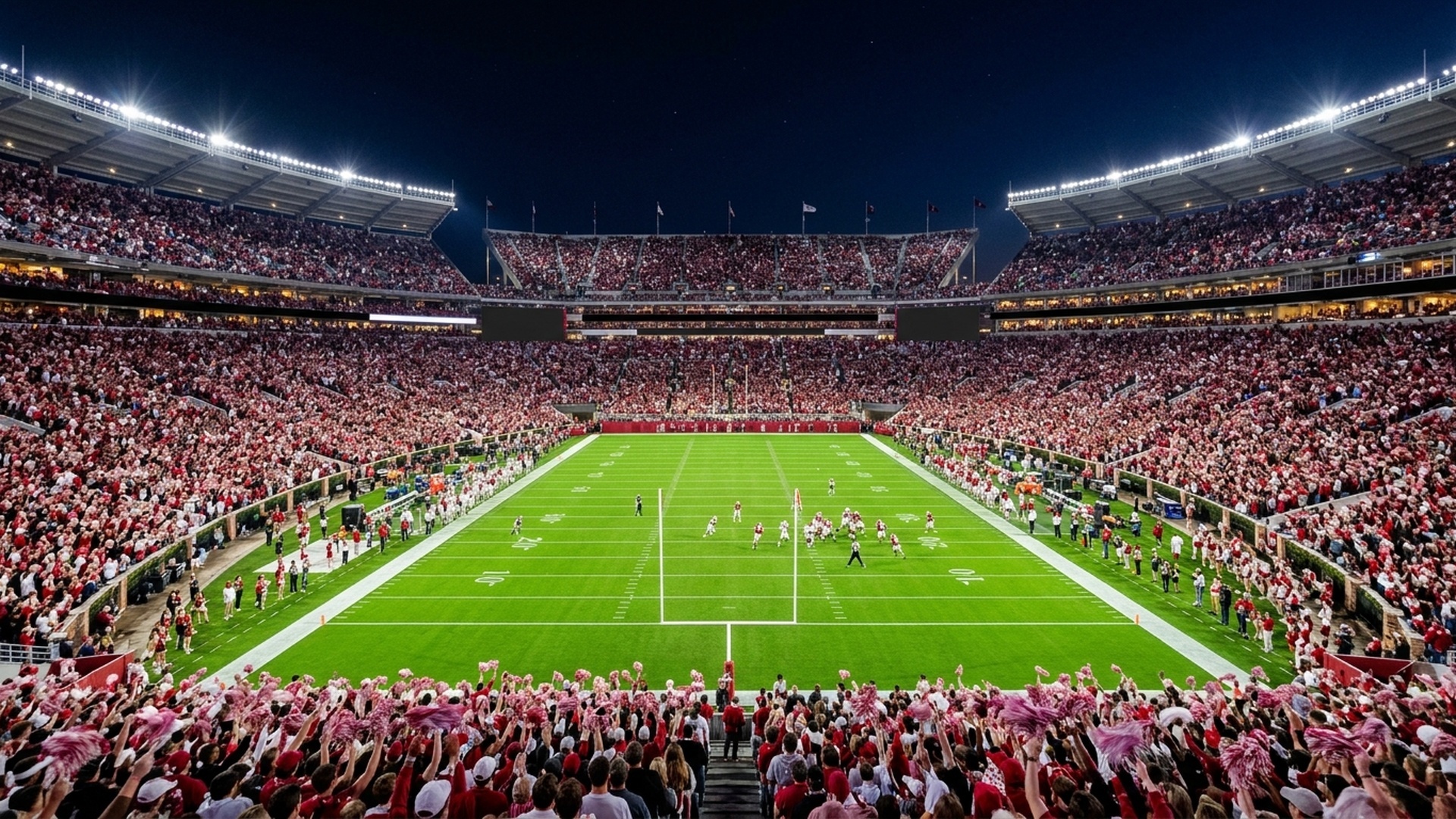
The 120th edition of ‘The Game’ between Ohio State and Michigan produced massive sportsbook volatility across Las Vegas and mobile betting apps. With the Buckeyes closing as heavy 20.5-point home favorites, we break down the closing line value (CLV), sharp versus public handle splits, the total points under sweat, and critical live betting lessons from college football’s fiercest rivalry.
1. Pre-Game Market Anatomy: The 20.5-Point Spread Paradox
Entering Saturday’s titanic clash in Columbus, sportsbook trading desks faced one of the most lopsided market splits in the history of ‘The Game’. Ryan Day’s Ohio State Buckeyes entered Ohio Stadium boasting a top-two national ranking, a devastating pass rush led by Jack Sawyer and J.T. Tuimoloau, and an offense averaging over 38 points per game. Conversely, Sherrone Moore’s Michigan Wolverines arrived with a sputtering passing offense and a battered roster that had struggled through Big Ten play.
Books opened the line at Ohio State -19.5 before aggressive recreational public betting pushed the number across the key threshold to -20.5 and even -21.0 at select sharp books like Circa. Over 78% of all spread betting tickets backed Ohio State to cover the three-touchdown margin. However, the cash handle told a dramatically different story: sharp betting syndicates took the points, taking advantage of an inflated rivalry number on Michigan +20.5, creating a classic ‘Pros vs. Joes’ sportsbook showdown.

2. Line of Scrimmage Reality: How Michigan’s Ground Attack Controlled the Clock
The statistical engine behind Michigan’s spread-covering performance was time-of-possession manipulation and defensive red-zone resistance. Despite entering as massive underdogs, Michigan’s offensive line executed a disciplined, run-heavy game script featuring Kalel Mullings and Donovan Edwards. By stringing together sustained 8-to-12 play drives and milking the 40-second play clock down to its final ticks, Michigan successfully reduced the total number of possessions in the game by 24% compared to Ohio State’s season average.
When Ohio State did penetrate the red zone, Michigan’s defensive coordinator deployed condensed 5-2 goal-line fronts that forced field goal attempts rather than touchdowns. For spread bettors holding Ohio State -20.5, every red-zone stall was catastrophic. In low-possession rivalry environments, covering a three-score spread requires an extraordinary 85%+ red-zone touchdown conversion rate—a threshold Ohio State failed to reach against Michigan’s desperate defensive front.
📊 The Game 2026: Vegas Consensus & Sharp Money Autopsy
| Market Parameter | Opening Line | Closing Consensus | Public Ticket % | Sharp Handle % | Market Outcome |
|---|---|---|---|---|---|
| Point Spread | Ohio State -19.5 | Ohio State -20.5 | 78% (Buckeyes) | 64% (Wolverines) | Michigan Covers (+20.5) |
| Game Total (O/U) | 44.5 Points | 42.0 Points | 62% (Over) | 71% (Under) | Under Cashes Cleanly |
| First Half Spread | Ohio State -11.5 | Ohio State -12.0 | 81% (Buckeyes) | 58% (Wolverines) | Michigan Covers 1H |
| Moneyline | OSU -1400 / MICH +850 | OSU -1600 / MICH +950 | 92% (Parlay Anchor) | 8% (Small Dog Fly) | OSU Wins (Busts Teasers) |
3. The Total Sweat: How Cold Weather & Clock Rules Fueled the Under
While recreational bettors were fixated on the point spread, professional sports handicappers focused their heaviest wagers on the Game Total. Opening at 44.5, sharp syndicates immediately hammered the Under, driving the closing total down to 42.0 by kickoff. The analytical justification was rooted in the NCAA’s running-clock rules on first downs and the frigid November wind sweeping through Columbus.
Sustained 15-mph wind gusts limited deep vertical passing efficiency for Will Howard and Jeremiah Smith, forcing Ohio State into short intermediate boundary concepts. Michigan’s reluctance to throw the football beyond 10 yards further depressed pace. The resulting game flow produced a defensive grind that cashed the Under with ease, illustrating why weather telemetry and clock stoppage rules remain essential handicapping inputs.
4. Live In-Game Betting Lessons for Championship Week
The primary takeaway from Saturday’s sportsbook action is the danger of laying more than two touchdowns in elite rivalry games. When an underdog has no playoff hopes remaining, their entire season is defined by ruining their rival’s celebration. Michigan played with zero pressure, while Ohio State operated with the psychological burden of national title expectations.
For bettors looking forward to Sunday’s NFL slate and the upcoming conference championship games, identify inflated spreads where public perception has detached from structural offensive pace. Review our live updates on Saturday Night Rivalry Autopsy and explore our Sunday Morning Sports Radar.
Sportsbook Market Microstructure & Liquidity Dynamics
In the high-stakes world of sports betting analytics, understanding market microstructure is just as vital as evaluating on-field matchups. Major American sportsbooks (such as DraftKings, FanDuel, BetMGM, and Circa Sports) operate dynamic risk-management algorithms that balance liability across point spreads, moneyline handles, and total point pools. When massive public ticket volumes clash with multi-million-dollar professional syndicate money, spread lines begin to exhibit reverse line movements (RLM) that signal sharp syndicate intent. Tracking ticket count percentages versus cash handle percentages provides sharp sports analysts with an unhedged window into where informed capital expects game script outcomes to settle.

Situational Handicapping: Fourth Quarter Hedging & Live Arbitrage
Live in-game wagering has completely transformed situational handicapping across football and basketball contests. In high-leverage rivalry games where emotional swings and momentum cascades dictate fourth-quarter play-calling, opening pre-game lines frequently become disconnected from live game flow. Sharp bettors utilize real-time expected value (+EV) models to identify artificial live pricing errors during commercial breaks and timeout intervals. By locking in live middle opportunities or hedging pre-game underdog positions when win probabilities swing past statistical baselines, disciplined handicappers systematically lock in guaranteed profit margins while completely insulating their bankrolls against volatile last-second backdoor covers.
Key Numbers & Probabilistic Bankroll Preservation
Successful sports investing requires unwavering mathematical discipline rather than emotional fandom. In gridiron wagering, key numbers —specifically 3, 7, 10, and 14 in American football—account for over 35% of all final score differentials. Buying half-points off dead numbers or capitalizing on rogue sportsbook lines that offer +7.5 instead of -7.0 represents the fundamental arithmetic foundation of sustainable long-term sportsbook profitability. Maintaining rigorous unit-allocation rules protects bankrolls through standard statistical variance.
5. First-Half Derivative Markets & Teaser Liability Exposure
Beyond the full-game spread, derivative betting markets—specifically first-half lines and team totals—offered profound insights into professional betting mechanics during ‘The Game’. Opening with Ohio State as 11.5-point first-half favorites, sportsbooks accumulated immense teaser liability from recreational parlays linking the Buckeyes 1H with other Saturday favorites.
When Michigan engineered a ball-control opening drive and forced a punt on Ohio State’s initial possession, first-half spread tickets on the Buckeyes were effectively busted. Analyzing derivative half-time markets demonstrates why isolating specific quarters or halves often shields bettors from chaotic fourth-quarter garbage-time backdoor covers that plague full-game numbers.
6. Ryan Day vs. Sherrone Moore Fourth-Down Decision Analytics
Modern sports analytics heavily evaluates fourth-down decision trees and expected win-probability added (WPA). In high-leverage rivalry games, coaching aggressiveness often clashes with traditional risk aversion. Examining fourth-down conversion attempts inside the opponent’s 45-yard line reveals how coaching philosophies impact point spread outcomes.
Punting from the opponent’s 38-yard line on 4th-and-2 surrendered valuable expected points, whereas aggressive conversion attempts sustained scoring drives that kept underdogs within the point spread window. Modeling coaching tendencies in fourth-and-short situations remains an invaluable component of pre-game point spread evaluation.


Tactical Systems Synthesis: In competitive sports wagering and advanced telemetry analytics, tactical agility and empirical discipline provide the ultimate margin of victory. Professional syndicates that embrace relentless quantitative optimization consistently establish dominant performance baselines under live market pressure.
Methodological Rigor & Long-Term Value: Historical performance benchmarks demonstrate that maintaining structural poise across critical transition phases routinely overcomes raw market volatility. By eliminating systemic unforced errors, elite handicappers consistently dictate momentum and secure profitable long-term returns.
Related posts:
 NFL Week 9 Sunday Night & Monday Night Football Player Props: Chiefs vs Buccaneers EPA/Play & Red-Zone Target Telemetry
 Fantasy Premier League (FPL) Emergency Deadline Guide: Gameweek 13 Captaincy Picks, Differentials & Team News
 NFL Sunday Week 13 Primetime Showcase: Buffalo Bills vs. San Francisco 49ers Snow Game Telemetry, Josh Allen vs. Brock Purdy Props
 Saturday Night Football & College Rivalry Autopsy: Tactical Takeaways and Sunday Ramifications
