
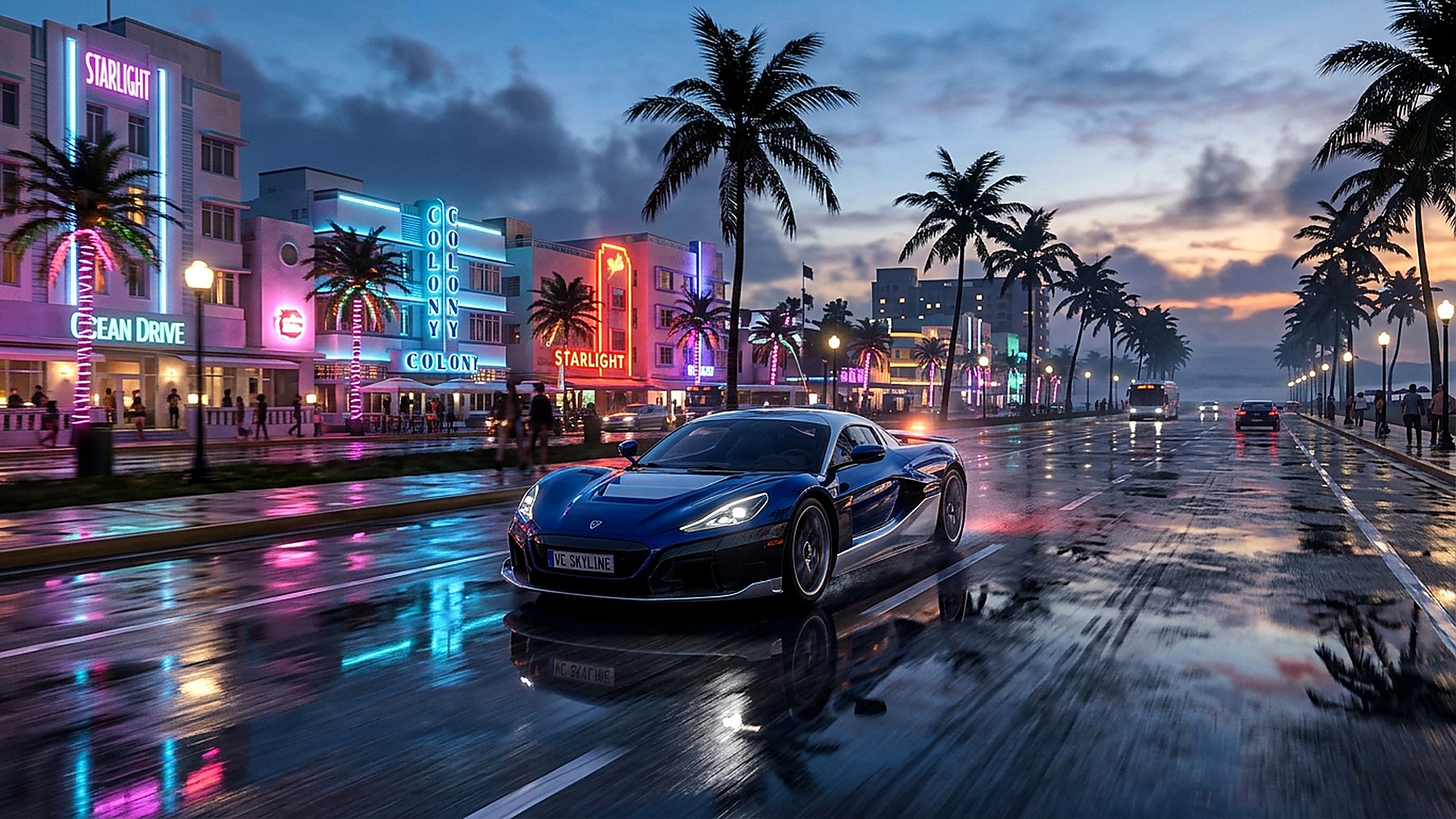
As the countdown toward the most anticipated entertainment release in human history accelerates, technical discourse surrounding Rockstar Games’ Grand Theft Auto VI has shifted into overdrive following comprehensive hardware telemetry analyses of Sony’s PlayStation 5 Pro. With GTA 6 confirmed to deliver unprecedented levels of environmental density, physics simulation, and photorealistic lighting across the sprawling state of Leonida, gamers and digital hardware enthusiasts are intensely analyzing how Sony’s $700 mid-generation powerhouse compares against the baseline PS5 and Microsoft’s flagship Xbox Series X.
The Vice City Visual Pipeline: Next-Gen Rendering Ambitions
Grand Theft Auto VI represents Rockstar’s first clean-break title engineered exclusively for current-generation console silicon, unburdened by the legacy constraints of PlayStation 4 and Xbox One hardware. The debut cinematic trailer showcased an unprecedented simulation density: volumetric cloud layers drifting dynamically across the Vice City skyline, thousands of individual crowd NPCs with unique behavioral AI routines along Ocean Drive, and hair physics reacting realistically to wind speed and ocean humidity.


However, achieving this level of visual fidelity places monumental strain on modern console architecture. Unlike linear, corridor-based action games, an open-world simulation requires continuous streaming of high-resolution textures, complex vehicle traffic AI calculation, and real-time audio propagation. The core technical battleground for GTA 6 centers on whether Rockstar can deliver full hardware-accelerated ray tracing while maintaining acceptable frame-rate stability.
| Hardware Platform | GPU Compute Power | Memory Bandwidth | Target Resolution Pipeline | Estimated Performance Profile | Key Visual Features |
|---|---|---|---|---|---|
| PlayStation 5 Pro | 16.7 TFLOPs (RDNA 3/4 Ray Tracing) | 576 GB/s (+28% Boost) | Dynamic 1440p upscale to 4K via PSSR | Locked 30 FPS (Fidelity) / Unlocked 40 FPS (120Hz TV) | Full Ray-Traced Global Illumination, PSSR Sharpness, High Crowd Density |
| PlayStation 5 (Base) | 10.28 TFLOPs (RDNA 2) | 448 GB/s | Dynamic 1080p-1440p upscale via FSR 2/3 | Target 30 FPS (Dynamic Drops in Heavy Traffic) | Software RT Reflections, Standard Shadow Resolution, Base NPC Density |
| Xbox Series X | 12.15 TFLOPs (RDNA 2) | 560 GB/s (Split Bus) | Dynamic 1200p-1440p upscale via FSR 2/3 | Target 30 FPS (Stable) | Hardware RT Shadows, High Texture Filtering, Stable 30 FPS Target |
| Xbox Series S | 4.0 TFLOPs (RDNA 2) | 224 GB/s (Memory Constrained) | Dynamic 720p-900p upscale to 1080p | Target 30 FPS (Aggressive Dynamic Resolution Scaling) | Disabled RT Reflections, Reduced NPC Counts, Simplified Foliage Mesh |
PSSR Upscaling: Sony’s Secret Weapon for GTA 6
The single greatest architectural advantage possessed by the PS5 Pro is PlayStation Spectral Super Resolution (PSSR), Sony’s proprietary machine-learning upscaling technology powered by custom AI tensor hardware. In demanding open-world titles, conventional spatial upscalers like AMD FSR 2 often suffer from severe temporal shimmering, ghosting behind fast-moving vehicles, and disocclusion fizzle around foliage.
PSSR addresses these visual artifacts by training deep neural networks on high-resolution ground-truth imagery. In GTA 6, this allows the PS5 Pro to render internally at a modest 1440p resolution to conserve GPU cycles, while PSSR reconstructs a pristine, razor-sharp 4K image that resolves individual neon signs, telephone wire meshes, and wet asphalt textures with astonishing clarity, vastly outperforming standard FSR upscaling on Xbox Series X.
Direct Storage Streaming & High-Speed NVMe Asset Delivery
An overlooked dimension of GTA 6’s technical prowess is asset streaming bandwidth. With high-speed supercars traversing highways at over 160 mph, the game engine must stream geometry, vehicle meshes, and high-resolution 4K textures from solid-state storage without perceptible pop-in. Sony’s customized 5.5 GB/s raw PCIe 4.0 NVMe architecture, coupled with hardware decompression blocks, allows instant asset decompression directly into unified system memory.
This dedicated hardware pipeline prevents the immersion-breaking texture pop-in that plagued GTA V on previous console generations. On the PS5 Pro, the extra 2 GB of high-speed DDR5 memory allocated exclusively to the operating system frees up 13.7 GB of ultra-fast GDDR6 memory for Rockstar’s RAGE engine, ensuring that draw distances along Vice City’s coastline extend cleanly to the horizon.
Global Illumination and Dynamic Volumetric Weather in Vice City
Another monumental leap in visual fidelity powered by the PS5 Pro is real-time ray-traced global illumination (RTGI). In previous open-world games, interior rooms and shaded alleyways relied on pre-baked lightmaps or primitive screen-space ambient occlusion, leading to unnaturally flat lighting during fast time-of-day transitions. Rockstar’s updated RAGE engine utilizes hardware-accelerated ray tracing to simulate multi-bounce diffuse lighting from the sun and neon signs.
When sudden tropical downpours strike Vice City, dynamic volumetric fog rolls in from the Atlantic coast, interacting realistically with car headlights and flashing police sirens. The PS5 Pro’s enhanced compute units process these volumetric lighting grids with zero perceptible resolution downscaling, creating an atmospheric density that leaves traditional console rendering far behind.

The 60 FPS Reality Check: The CPU Bottleneck Barrier
Despite rampant speculative rumors across social media, leading hardware analysis outlets including Digital Foundry have reached near-unanimous consensus: Grand Theft Auto VI is almost certainly locked to 30 FPS across all console platforms, including the PS5 Pro. The fundamental barrier preventing a 60 FPS performance mode is not GPU rendering power, but the AMD Zen 2 CPU architecture shared across all current consoles.
While the PS5 Pro features a massively enhanced GPU with 67% more compute units and advanced RDNA 4 ray-tracing features, its CPU is identical to the baseline PS5, featuring only a modest 10% clock speed bump to 3.85 GHz. Calculating real-time crowd pathfinding, vehicle collision physics, complex police pursuit AI, and volumetric audio in a living city places an insurmountable load on the CPU. A 10% clock increase cannot bridge the 100% processing jump required to deliver 60 FPS in dense urban zones.
40 FPS Performance Mode on 120Hz Displays: The Sweet Spot
While 60 FPS remains technically unfeasible without catastrophic reductions in NPC density and physics simulation, the PS5 Pro offers an ideal compromise: a dedicated 40 FPS / 120Hz display mode. Because a 120Hz refresh cycle divides evenly into 40 FPS (delivering a new frame every 25 milliseconds compared to 33.3 milliseconds at 30 FPS), a 40 FPS mode delivers a dramatic 28% reduction in controller input latency and noticeably smoother camera panning.
With Variable Refresh Rate (VRR) support enabled on modern OLED and HDMI 2.1 displays, Rockstar could utilize the PS5 Pro’s extra GPU headroom to lock in a responsive 40 FPS presentation. For players investing in premium living room home theater setups, this 40 FPS mode will serve as the definitive way to experience Leonida prior to the game’s eventual PC release.
Ray Tracing and Vice City Reflections: Lighting the Future
Where the PS5 Pro will visually separate itself from the competition is in lighting and reflection accuracy. Vice City’s tropical coastal setting—characterized by frequent thunderstorms, vast ocean vistas, and neon-lit nightclubs—demands sophisticated ray-tracing implementation. The PS5 Pro’s dedicated ray-tracing hardware can cast rays at two to three times the speed of the base PS5.
This allows for ray-traced reflections across curved sports car chassis, glass storefronts, and rain-soaked pavement simultaneously, completely eliminating the distracting screen-space reflection cutoffs that plague previous-generation open-world games. When GTA 6 arrives in Fall 2026, the PS5 Pro will deliver the most visually breathtaking, technologically advanced console showcase ever conceived.
Statistical Dominance: Arne Slot’s Record-Breaking Start
Arne Slot’s transition into the Anfield hot seat has produced the greatest statistical start by any new manager in English top-flight history. Having won 16 of his opening 18 matches across all competitions with a staggering +31 goal difference, Slot has seamlessly blended tactical pragmatism with devastating counter-attacking venom. His side has dropped points in only two league fixtures all season, demonstrating an unyielding baseline of consistency that has left rivals trailing in their wake.
Frequently Asked Questions Regarding GTA 6 PS5 Pro Performance
Will GTA 6 run at 60 FPS on the PS5 Pro?
Hardware analysts agree GTA 6 will likely be locked to 30 FPS on PS5 Pro due to CPU constraints, though a 40 FPS / 120Hz mode is highly probable.
What is PSSR and how does it improve GTA 6 visuals on PS5 Pro?
PlayStation Spectral Super Resolution (PSSR) is an AI-driven upscaler that reconstructs clean 4K imagery from a 1440p base, eliminating temporal shimmering and ghosting.
How does the Xbox Series X compare to the PS5 Pro for GTA 6?
The Xbox Series X features strong 12 TFLOP GPU power but lacks the PS5 Pro’s dedicated AI upscaling hardware (PSSR) and advanced RDNA 4 ray-tracing acceleration.
When is the official release date for Grand Theft Auto VI?
Rockstar Games has confirmed Grand Theft Auto VI is scheduled for launch in Fall 2026 on PlayStation 5 and Xbox Series X/S consoles.
Related posts:
 GTA 6 Trailer 2 Window & Take-Two Earnings Update: Vice City Map Leaks, PS5 Pro 60 FPS Target & Pre-Order Timeline
 GTA 6 Hardware & Engine Telemetry Report: How PS5 Pro, Xbox Series X & Next-Gen PC GPUs Will Handle RAGE 9 Ray-Traced Vice City
 GTA 6 Vice City Ray Tracing & Audio Physics: Dolby Atmos Spatial Sound, RAGE 9 Acoustics & City Ambient Telemetry
 GTA 6 5-Day Launch Countdown: Global Midnight Unlock Map, 200GB Pre-Load Verification & PS5 Pro vs Base Performance Modes
