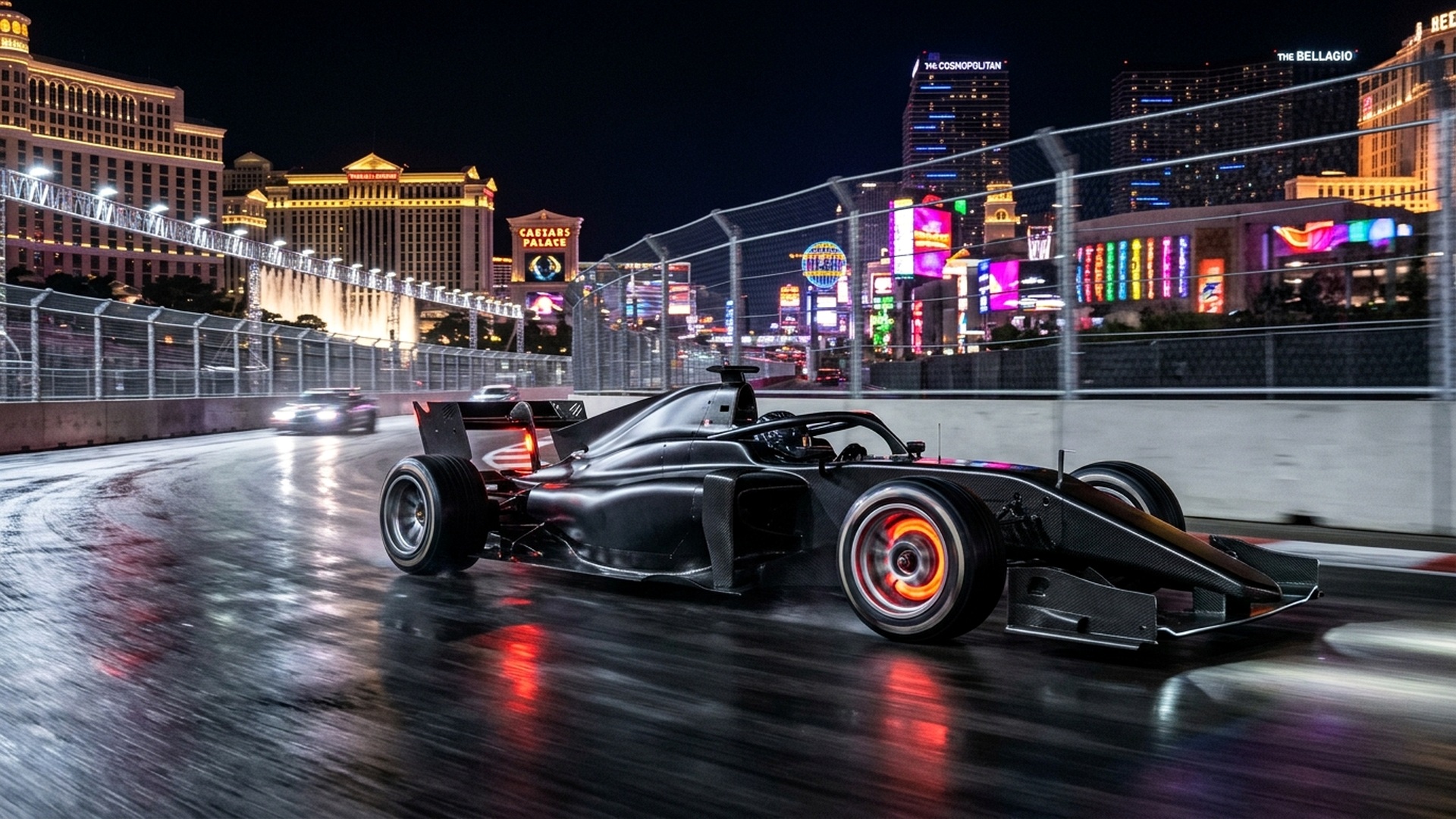
The glittering jewel of the modern Formula 1 calendar comes alive this weekend as the 2026 Heineken Silver Las Vegas Grand Prix roars under midnight desert skies and millions of neon lumens along the iconic Las Vegas Strip. Spanning 50 high-octane laps around the brutal 6.201-kilometer street circuit, Sunday’s race represents one of the most strategically punishing, mechanically extreme tests in world motorsport. With ambient air temperatures hovering around a frosty 12 degrees Celsius and track surface temperatures barely reaching 15 degrees, drivers face an unprecedented dual challenge: keeping Pirellis alive while sustaining 350 km/h slipstreaming duels inches from unforgiving concrete walls.
Mercedes sensation George Russell leads the pack from pole position, having extracted a sublime, error-free lap in Q3 to deny Ferrari’s Carlos Sainz by less than a tenth of a second. However, starting from the dirty side of the grid on cold public asphalt presents immediate launch vulnerabilities. Lurking dangerously in third position is championship leader Max Verstappen, whose Red Bull RB20 boasts unmatched straight-line efficiency and superior race-pace tire degradation management.
Behind the leading trio, the constructors’ championship war between Ferrari and McLaren reaches boiling point. With Charles Leclerc lining up fourth and McLaren’s Lando Norris fighting from sixth after qualifying struggles, the pit wall strategists in Maranello and Woking are preparing complex split-strategy undercuts to capture crucial world championship points.
| Race Parameter | Grand Prix Data & Track Dimensions | Tactical Significance |
|---|---|---|
| Circuit Layout & Distance | Las Vegas Strip Circuit (6.201 km, 50 Laps, 309.95 km) | Second-longest track on calendar; speeds exceeding 350 km/h |
| Starting Grid Front Row | P1: George Russell (Mercedes) | P2: Carlos Sainz (Ferrari) | Tight launch sprint into Turn 1 hairpin with cold tires |
| Weather & Ambient Temp | 12.4°C Air | 15.1°C Track (Cold Desert Midnight) | Extreme front-tire graining and brake glazing hazard |
| Safety Car Probability | 85% Historical Likelihood (1.6 Deployments Avg) | Zero runoff areas mean minor clashes trigger instant SC |
Tactical Matchup: Russell’s Launch vs Verstappen’s Straight-Line Weaponry
The defining tactical axis of the opening stint centers on George Russell’s ability to defend into Turn 1 against the straight-line top speed of Ferrari and Red Bull. Telemetry from Friday’s long-run simulations demonstrated that the Red Bull RB20 and Ferrari SF-24 generate massive top-end velocity advantages down the 1.9-kilometer Strip straight, with Verstappen clocking 351.4 km/h through the speed trap compared to Russell’s 346.8 km/h. If Russell cannot establish a gap exceeding one second before DRS is activated on Lap 2, Verstappen and Sainz will breeze past using the powerful slipstream effect.
Furthermore, managing brake temperatures presents a terrifying technical headache for all twenty drivers. Along the nearly two-kilometer blast down Las Vegas Boulevard, carbon-carbon brake discs plummet below their optimal operating window (400°C-600°C). When drivers slam on the anchors from 350 km/h down to 80 km/h for the tight Turn 14 chicane, glazed pads and cold front tires trigger instantaneous front-wheel lockups. A single flat-spot on the hard C3 tire can ruin a 25-lap stint, forcing an emergency unscheduled pit stop.
In the mid-pack, McLaren’s Lando Norris and Oscar Piastri must navigate early traffic. Starting sixth and eighth respectively, the McLarens suffered from straight-line drag in qualifying. However, McLaren’s tire degradation in race trim is historically the best on the grid. If Norris can preserve his medium compound while the leaders tear up their front tires in early dogfights, the Briton can execute powerful overcut strategies during the first pit window.
Turn 1 remains the primary accident flashpoint. Cold tires, twenty cars braking together into a 90-degree left-hander, and low grip public asphalt guarantee heart-stopping opening lap tension.
| Driver & Grid Position | Starting Tire Compound | Top Speed (Trap) | Strategic Race Strength |
|---|---|---|---|
| George Russell (P1) | Pirelli C4 Medium (Yellow) | 346.8 km/h | Elite low-speed mechanical traction through Sector 1 |
| Carlos Sainz (P2) | Pirelli C4 Medium (Yellow) | 350.2 km/h | Low-drag aerodynamic package and rapid tire warmup |
| Max Verstappen (P3) | Pirelli C4 Medium (Yellow) | 351.4 km/h | Fastest straight-line speed; lethal cold-tire racecraft |
| Charles Leclerc (P4) | Pirelli C4 Medium (Yellow) | 349.8 km/h | Aggressive late-braking and tire management |
| Lando Norris (P6) | Pirelli C4 Medium (Yellow) | 345.2 km/h | Superior tire degradation preservation over long stints |
Pirelli Tire Strategies: One-Stop Optimum vs Safety Car Chaos
Pirelli’s technical engineering briefing outlines three distinct strategic pathways for the 50-lap race. The mathematically fastest baseline strategy is a standard one-stop: starting on the medium C4 compound for 18 to 22 laps before switching to the durable hard C3 compound to reach the chequered flag. The hard tire exhibits virtually zero thermal degradation once brought up to temperature, allowing drivers to push flat-out across the final 30 laps.
However, the smooth public asphalt creates severe front-left tire graining. In cold conditions, the outer surface of the tire tears away in micro-shreds before the core rubber is warm, causing sudden understeer in Turn 1 and Turn 7. Drivers who overdrive in the opening five laps will experience a dramatic drop-off in grip, opening the door for two-stop strategies (Medium – Hard – Soft) if late Safety Cars bunch the field together.
With an 85% statistical probability of a Safety Car deployment in Las Vegas, pit wall reaction times will make or break races. A ‘free pit stop’ under Safety Car conditions costs just 11.5 seconds compared to 21.0 seconds under green-flag racing. Teams that pit immediately upon yellow-flag deployment gain a monumental ten-second advantage over competitors caught on the opposite side of the circuit.
Track evolution is another vital factor. As sixty cars lay down sticky rubber over the weekend, grip levels increase by nearly 1.5 seconds per lap from Friday practice to Sunday race night.
| Strategy Pathway | Stint 1 (Tire & Laps) | Stint 2 (Tire & Laps) | Strategic Risk / Reward |
|---|---|---|---|
| Optimal One-Stop (Standard) | C4 Medium (Laps 1-20) | C3 Hard (Laps 21-50) | Lowest total race time; vulnerable to mid-race Safety Cars |
| Alternative One-Stop (Overcut) | C3 Hard (Laps 1-30) | C4 Medium (Laps 31-50) | High overcut potential; vulnerable to cold tire launch on grid |
| Aggressive Two-Stop (Sprint) | C4 Medium (Laps 1-15) | C3 Hard (16-36) | C5 Soft (Laps 37-50) | Devastating attack pace if late Safety Car bunches the pack |
Betting Market Intelligence & Grand Prix Winner Odds
Following his pole-winning lap, George Russell sits as the 2.60 favorite on international sportsbooks. However, professional Formula 1 betting models favor Max Verstappen at 3.00, citing Red Bull’s superior top-speed telemetry and Verstappen’s historic prowess on restart phases. Carlos Sainz offers compelling value at 4.25, while Charles Leclerc represents an enticing 5.50 dark-horse podium selection.
Prop markets offer high-yield angles around race attrition. The ‘Over 1.5 Safety Car Deployments’ prop trades at 1.70, reflecting the razor-thin margins of error between the barriers. Furthermore, ‘Fastest Lap’ markets are dominated by Verstappen and Norris, who frequently pit for fresh soft rubber in the final five laps if they hold a sufficient pit window buffer to cars behind.
Expect a chaotic, slipstreaming Grand Prix down the Strip straight where straight-line speed and tactical composure under Safety Car restarts ultimately crown Max Verstappen or Carlos Sainz over George Russell in an unforgettable Las Vegas thriller.
| Driver | Starting Grid Position | Outright Win Odds | Podium Finish Odds |
|---|---|---|---|
| George Russell (Mercedes) | P1 (Pole Position) | 2.60 | 1.35 |
| Max Verstappen (Red Bull) | P3 | 3.00 | 1.40 |
| Carlos Sainz (Ferrari) | P2 | 4.25 | 1.55 |
| Charles Leclerc (Ferrari) | P4 | 5.50 | 1.70 |
Frequently Asked Questions (FAQ)
What time does the 2026 Las Vegas Grand Prix start?
The 50-lap race starts at 22:00 local time on Saturday night in Nevada (06:00 GMT / 11:30 IST on Sunday morning, November 22).
Who started on pole position for the Las Vegas GP?
Mercedes driver George Russell captured pole position with a Q3 lap time of 1:32.312, narrowly edging Ferrari’s Carlos Sainz by 0.098 seconds.
Where can I watch the Las Vegas Grand Prix live?
In the United States, the race airs live on ESPN and ESPN+. In the UK, it is shown on Sky Sports F1, while international viewers can stream via F1 TV Pro.
How many laps is the Las Vegas Grand Prix?
The race is scheduled for 50 laps around the 6.201 km Las Vegas Strip Circuit, totaling a total racing distance of 309.95 kilometers.
Related posts:
 Lisandro Martinez Statement: Man United Defender Meets Carrick & Hierarchy Ahead of Leeds Clash
 Mikel Arteta Tactical Crisis: How Arsenal Rebuilds After William Saliba Red Card Ahead of Liverpool Blockbuster
 Real Madrid Tchouameni Injury Scare Leaves José Mourinho Awaiting Scans After France Statement
 Man Utd Michael Carrick Plan Emerges Ahead of Monaco Summit: Targeting Bayern’s Aaron Danks