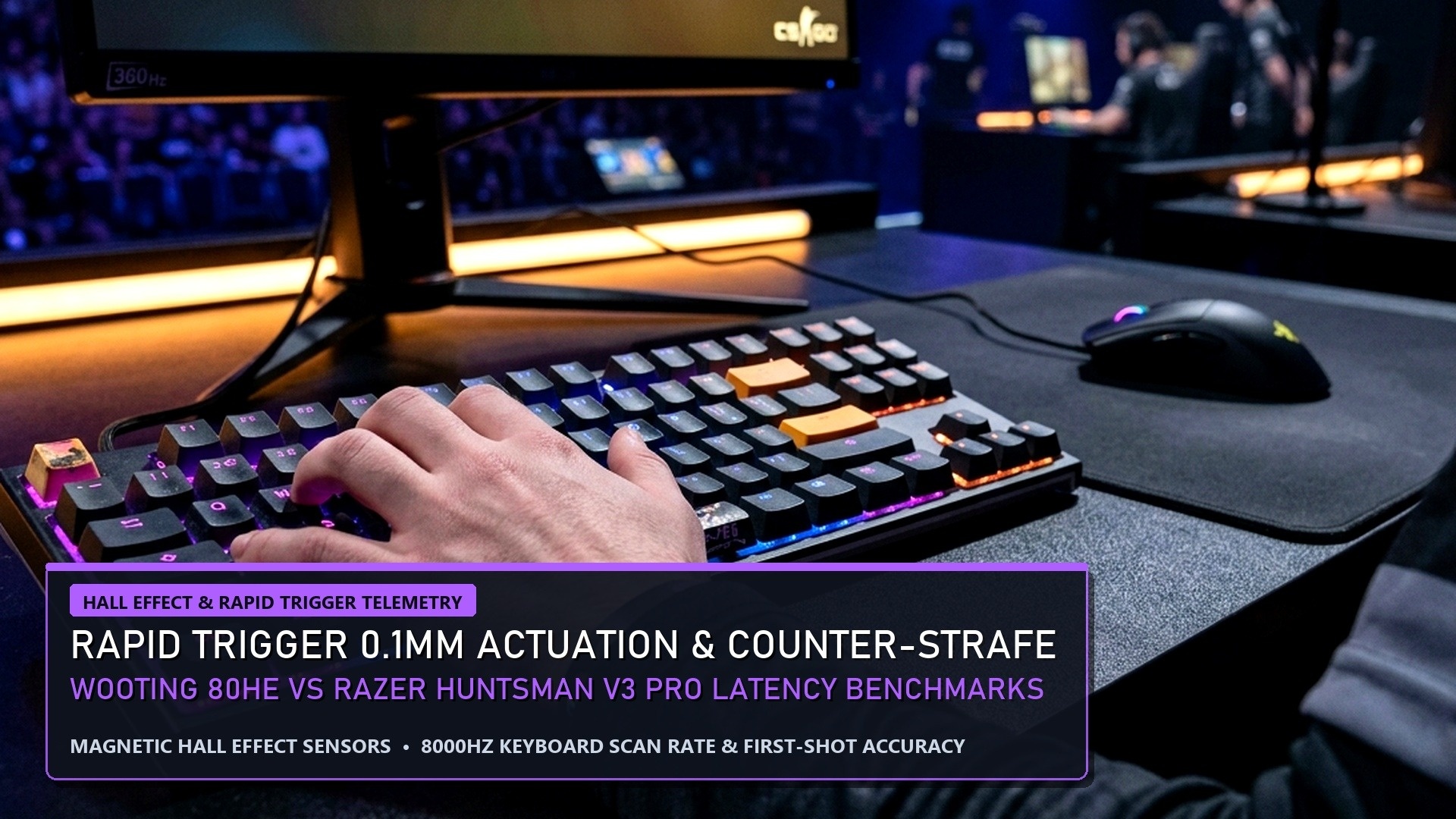
The competitive PC gaming peripheral landscape has experienced a monumental paradigm shift over the past two years. Traditional mechanical switches, which rely on physical metal leaf contacts to register keypresses, are rapidly becoming obsolete in top-tier esports tournaments. In their place, magnetic Hall Effect switches equipped with Rapid Trigger technology and 8,000Hz (8KHz) hyper-polling have emerged as the mandatory gold standard for professional Valorant, Counter-Strike 2, and Apex Legends athletes.
Meanwhile, optical switch proponents argue that light-actuated switches offer equal speed without potential magnetic interference. Which technology provides the lowest total input latency and the most consistent counter-strafing performance? In this comprehensive hardware guide, we analyze magnetic flux sensors, dynamic actuation points, SOCD firmware regulations, and compare premier market offerings from Wooting, Razer, SteelSeries, and Keychron.

1. How Hall Effect & Rapid Trigger Actually Work
Traditional mechanical switches feature a static physical actuation point—typically around 2.0mm of downward key travel—and require the switch to bounce back up past a reset point (usually around 1.5mm) before another keypress can register. This mechanical design introduces inherent physical delay and requires “debounce filtering” algorithms (typically 2ms to 5ms) to prevent false double-clicks.
In contrast, Hall Effect switches utilize a permanent neodymium magnet mounted inside the switch stem, paired with an electromagnetic sensor on the printed circuit board (PCB). The sensor continuously measures subtle changes in the magnetic flux field as the key descends, allowing the keyboard microcontroller to calculate the key’s exact vertical position with 0.1-millimeter accuracy in real time.
“Rapid Trigger” leverages this analog telemetry to eliminate fixed reset points entirely. The microsecond your finger releases upward pressure by as little as 0.1mm, the key instantly deactivates; the microsecond you press back down by 0.1mm, it instantly reactivates. In Counter-Strike 2 and Valorant, this cuts counter-strafe stopping latency from ~45ms down to an astonishing ~8ms, allowing you to stop on a dime and fire perfectly accurate first-bullet headshots.
Hall Effect Magnetic vs Optical vs Traditional Mechanical Comparison
| Switch Architecture | Actuation Range | Rapid Trigger Reset | Debounce Delay | Key Life Durability | Esports Adoption |
|---|---|---|---|---|---|
| Hall Effect (Magnetic) | 0.1mm – 4.0mm (Adjustable) | Yes (Dynamic 0.1mm) | 0.0 ms (Zero debounce) | 100M+ Keypresses (No wear) | Dominant (85%+ Pro Use) |
| Optical Switches | 1.0mm – 1.5mm (Fixed) | Limited (Select models) | 0.2 ms | 100M+ Keypresses | Moderate (10% Pro Use) |
| Traditional Mechanical | 1.8mm – 2.2mm (Fixed) | No (Fixed reset gap) | 2.0 – 5.0 ms | 50M – 80M Keypresses | Declining (<5% Pro Use) |
2. The 8,000Hz (8KHz) Polling Debate: Does It Matter?
Standard gaming keyboards operate at a 1,000Hz USB polling rate, sending input reports to your operating system once every 1.0 millisecond. Modern flagships like the Wooting 80HE, Razer Huntsman V3 Pro, and Keychron Q1 HE feature 8,000Hz polling capabilities, reducing the packet interval to just 0.125 milliseconds (125 microseconds).
While shaving 0.875ms off electrical packet delivery is measurable in laboratory oscilloscopes, human reaction times range between 150ms and 200ms. However, the true value of 8KHz lies in input consistency and frame synchronization. When paired with a 360Hz or 540Hz gaming display, 8KHz input reports align closer to active monitor refresh scanlines, virtually eliminating micro-jitter during rapid directional AD-AD spam.
3. SOCD & Simultaneous Input Rules: The Valve & Riot Rulings
In mid-2024, keyboard manufacturers introduced firmware features like Razer’s “Snap Tap” and Wooting’s “Snappy Tappy” (Simultaneous Opposite Cardinal Direction, or SOCD). By automatically prioritizing the latest directional keypress without requiring the player to physically release the opposite key, players achieved effortless, mathematically automated counter-strafing.
Valve swiftly responded by banning automated SOCD firmware in Counter-Strike 2, implementing server-side telemetry kicks for players detected using hardware assistance. Riot Games similarly prohibits automated hardware macros in Valorant Champions Tour events. Crucially, standard Hall Effect Rapid Trigger remains 100% legal across all competitive esports because it relies entirely on physical finger movement rather than algorithmic key override.
4. Optimal Actuation Settings for Competitive Shooters
One common mistake novice players make with Hall Effect keyboards is setting every single key to the absolute minimum 0.1mm actuation point. While this maximizes initial activation speed, resting heavy fingers on WASD keys can trigger accidental movement during tense clutch moments, causing catastrophic crosshair bloom.
Top esports coaches recommend a tiered actuation profile:

- Movement Keys (W, A, S, D): 0.4mm Actuation Point, 0.15mm Rapid Trigger sensitivity.
- Jump & Crouch (Space, L-Ctrl): 0.6mm Actuation Point, 0.2mm Rapid Trigger sensitivity to prevent accidental slide-cancels.
- Ultimate / Utility Keys (Q, E, C, X): 1.2mm Actuation Point with standard release to prevent accidental fat-finger misfires.
Analog Movement Emulation: Smooth Joystick Simulation on PC
One of the most overlooked capabilities of Hall Effect keyboards is their ability to emulate analog gamepad joysticks directly through standard keyboard keys. Because the magnetic sensor reads the full 4.0mm continuous depth of key travel rather than a binary on/off state, specialized firmware can output graduated 0-to-100% analog axis values.
In vehicular driving games (such as GTA Online and Forza Motorsport) and stealth adventure titles, depressing the ‘W’ key slightly allows your character or vehicle to creep forward smoothly at 20% speed, while pressing fully to bottom-out triggers maximum acceleration. This eliminates the frustrating “binary tapping” required on traditional keyboards to maintain controlled steering angles around tight corners.
Furthermore, in tactical shooters with dynamic movement states, analog emulation allows you to transition seamlessly between slow walking and sprinting based on physical key pressure depth. This delivers the ergonomic fluidity of a controller without sacrificing the millimeter crosshair aiming speed of a gaming mouse.
As magnetic keyboard firmware continues to evolve throughout 2026, the boundaries between keyboard speed and controller nuance will continue to dissolve, giving PC enthusiasts the definitive competitive advantage across all gaming genres.
Web-Based Firmware & On-Board Profile Portability
A decisive advantage modern magnetic keyboard manufacturers possess over legacy peripheral giants is the adoption of lightweight, driverless web configurators. Leading platforms like Wootility and Keychron Launcher operate entirely inside Chromium web browsers via WebUSB APIs, eliminating the need to install bloated background software suites that consume valuable CPU cycles.
Every customization—including dynamic actuation depths, Rapid Trigger thresholds, RGB lighting profiles, and analog joystick mappings—saves directly onto the keyboard’s internal flash memory microcontroller. When traveling to local LAN tournaments, college gaming centers, or esports arenas, athletes can plug their keyboard into tournament-provided PC rigs and enjoy identical millimeter actuation behavior without installing administrative software.
This plug-and-play tournament reliability guarantees competitive athletes absolute confidence in their hardware execution across every match.
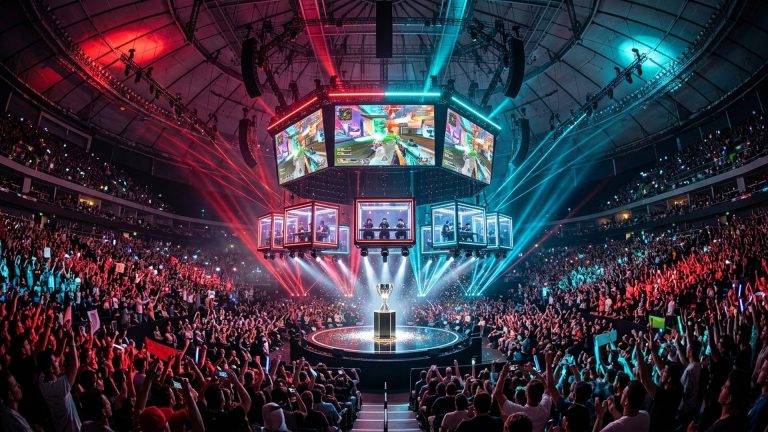
Furthermore, magnetic Hall Effect switches are completely impervious to dust, spilled liquids, and physical contact oxidation. While traditional mechanical leaves degrade over months of aggressive gaming, magnetic flux sensors maintain identical millimeter precision indefinitely, guaranteeing your peripheral investment remains tournament-ready for years to come.
5. Top Keyboard Recommendations for 2026
If you are ready to upgrade your battlestation, three keyboards stand as undisputed leaders. The Wooting 80HE remains the community benchmark, offering unmatched web-based software (Wootility), true 8KHz polling, and custom Gateron magnetic Lekker switches. For players who prefer traditional mainstream retail availability, the Razer Huntsman V3 Pro provides excellent Gen-2 optical-analog switches with robust aluminum chassis construction. Finally, the Keychron Q1 HE delivers custom-keyboard acoustic satisfaction, featuring CNC aluminum construction, gasket mounting, and wireless 2.4GHz connectivity.
Frequently Asked Questions (Hall Effect Keyboards)
Q1: Can magnets or external speakers interfere with Hall Effect keyboards?
Modern Hall Effect keyboards feature shielded PCBs that resist ambient electromagnetic interference. However, placing high-power magnetic smartphone chargers or heavy magnetic audio speakers directly on top of the keyboard chassis is not recommended.
Q2: Does Rapid Trigger work in rhythm games like osu!?
Yes! Rapid Trigger revolutionized high-BPM rhythm gaming, allowing osu! players to stream high-density finger taps at 300+ BPM with virtually zero finger fatigue.
Q3: Do Hall Effect switches need lubrication?
Most modern magnetic switches come factory-lubricated with Krytox grease. Because there are no physical leaf contacts causing scratchiness, Hall Effect switches remain exceptionally smooth throughout their entire lifespan.
Q4: Does 8000Hz polling consume high CPU resources?
On modern multi-core processors (AMD Ryzen 5000/7000/9000 or Intel 12th-14th Gen), 8KHz polling consumes less than 1.5% CPU overhead, causing zero perceptible impact on in-game framerates.
Related posts:
 PS5 Pro PSSR vs PC DLSS 3.7: Visual Fidelity, Frame Times & Ray Tracing Benchmarks
 The Billion-Dollar Overlap: Trending Sports Business News
 India vs New Zealand 1st Test Bengaluru: Sarfaraz Khan 150 & Rishabh Pant 99 Ignite Historic Fightback
 CS2 Shanghai Major 2026 Americas RMR Opening Round Matchups: Complexity, Liquid & Imperial Swiss Bracket Predictions