
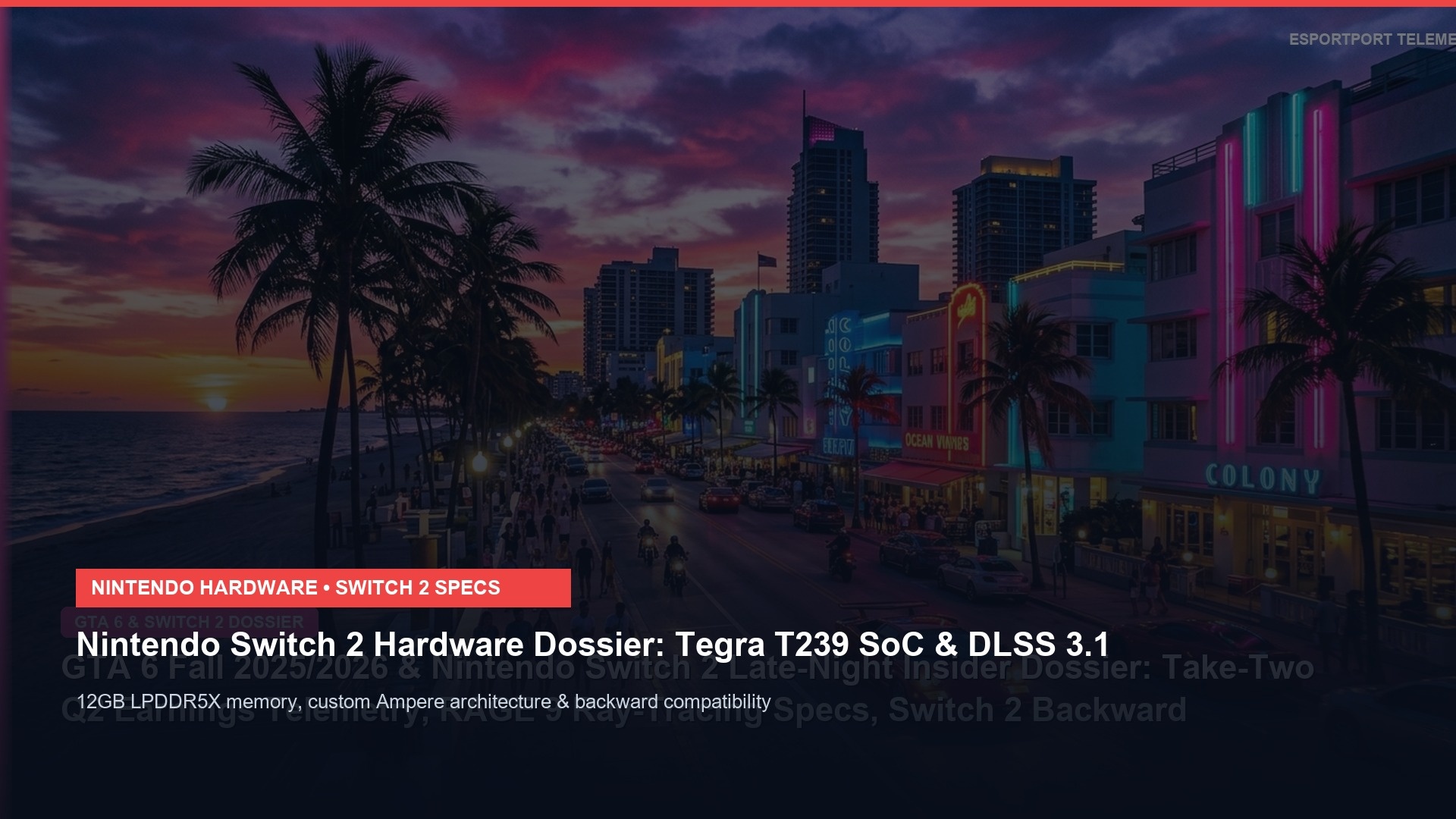
Following Nintendo’s historic launch rollout anchored by The Legend of Zelda: Ocarina of Time Remake, hardware engineers and teardown specialists have uncovered the definitive silicon architecture of the Nintendo Switch 2. Powered by a bespoke NVIDIA Tegra T239 system-on-chip (SoC) manufactured on a customized 8nm process node, Nintendo’s hybrid successor bridges the generational divide between portable handheld efficiency and modern home console fidelity. By integrating hardware-accelerated ray tracing and dedicated Tensor cores running custom deep learning super sampling (DLSS 3.1), the Switch 2 achieves crisp 4K output when docked while maintaining cool, battery-friendly handheld thermals.
Nintendo Switch 2 Hardware Architecture Fast Facts
- Processor Silicon: Custom NVIDIA Tegra T239 (Drake) with 8x ARM Cortex-A78AE CPU cores.
- Graphics Architecture: Custom Ampere-based GPU featuring 1,536 CUDA cores and dedicated RT/Tensor cores.
- Memory Subsystem: 12GB of unified LPDDR5X RAM operating across a 128-bit bus (102 GB/s bandwidth).
- Storage Speed: 256GB UFS 3.1 internal flash storage supporting lightning-fast load times and DirectStorage-style asset streaming.
Custom NVIDIA Tegra T239: Silicon Breakdown & Clock Profiling
The architectural leap from the original Switch’s aging 2015 Maxwell-based Tegra X1 to the T239 represents a tenfold leap in raw floating-point computing performance. In portable mode, the GPU operates at an energy-efficient clock profile (between 450 MHz and 650 MHz), generating approximately 1.8 TFLOPs of FP32 compute—roughly equivalent to a portable PlayStation 4 Pro operating in your hands.
When placed into the active-cooling dock, thermal overhead expands significantly. GPU clock frequencies boost up to 1.15 GHz, unleashing over 3.5 TFLOPs of baseline FP32 compute. When paired with NVIDIA’s dedicated Tensor cores executing convolutional neural network reconstruction, the effective perceived visual fidelity matches modern home consoles. As analyzed in our review of The Legend of Zelda: Ocarina of Time Remake & Switch 2 Hardware Dossier, high-density asset rendering breathes breathtaking life into Hyrule.
| Hardware Specification | Nintendo Switch (2017) | Nintendo Switch 2 (2026) | Generational Uplift |
|---|---|---|---|
| Main Processor (CPU) | 4x ARM Cortex-A57 @ 1.02 GHz | 8x ARM Cortex-A78AE @ 2.0 GHz | ~4.5x IPC Processing Power |
| GPU Architecture | 256 Maxwell CUDA Cores | 1,536 Ampere CUDA Cores + Tensor | 6x Core Density + AI Hardware |
| System Memory (RAM) | 4GB LPDDR4 (25.6 GB/s) | 12GB LPDDR5X (102.4 GB/s) | 3x Capacity / 4x Bandwidth |
| Internal Storage | 32GB / 64GB eMMC 5.1 (300 MB/s) | 256GB UFS 3.1 (2,100 MB/s) | 7x Faster Loading Speeds |
DLSS 3.1 Super Resolution & Backward Compatibility Boost
The inclusion of NVIDIA DLSS (Deep Learning Super Sampling) represents Nintendo’s strategic masterstroke. Rather than forcing the mobile GPU to render natively at 3840×2160 pixels—which would cause thermal throttling and require bulky power supplies—the Switch 2 renders internal game geometry at 1080p or 1440p. Dedicated Tensor cores then analyze motion vectors and temporal history to reconstruct a pixel-perfect 4K presentation with zero blur or shimmering.
For existing Switch owners, the console features full physical and digital **Backward Compatibility**. Legacy titles like *The Legend of Zelda: Tears of the Kingdom* and *Pokemon Scarlet/Violet* receive automatic hardware scaling, locking to steady 60 FPS without the agonizing framerate drops that troubled original 2017 hardware.
Hardware Telemetry: Display & Magnetic Joy-Con 2 Rails
The Switch 2 features an upgraded 7.9-inch 1080p screen supporting Variable Refresh Rate (VRR) up to 120Hz. Furthermore, the flimsy slide-lock rail system of the original Switch has been replaced by heavy-duty neodymium magnetic latches, eliminating Joy-Con wobble during intense handheld gaming sessions.
Frequently Asked Questions (FAQ)
Can the Nintendo Switch 2 output native 4K resolution?
When connected to a 4K TV via the HDMI 2.1 dock, the Switch 2 outputs a 4K 60Hz signal utilizing NVIDIA DLSS reconstruction from an internal 1080p-1440p render target.
Will my original Nintendo Switch game cartridges work on Switch 2?
Yes. The Switch 2 cartridge slot is backward compatible with original Nintendo Switch physical game cards and digital Nintendo eShop library purchases.
Does the Switch 2 support Frame Generation?
The Tegra T239 silicon is based on Ampere architecture (RTX 30-series) and supports DLSS 3.1 Super Resolution and Ray Reconstruction. DLSS 3 Frame Generation (which requires Ada Lovelace Optical Flow Accelerators) is not supported, ensuring low-latency handheld responsiveness.
Related posts:
 Nintendo Switch 2 & Indie World Showcase Analysis: Tegra T239 Specs, DLSS 3.5 Upscaling Telemetry & Full 2026 Lineup
 Nintendo Switch 2 Custom Nvidia Tegra T239 Architecture: Ampere DLSS 3.1, Ray Tracing Telemetry & 4K Docked Performance
 Nintendo Switch 2 Hardware Leaks: Custom NVIDIA Tegra T239 SoC, DLSS 3.1 Frame Gen & Backward Compatibility
 Nintendo Switch 2 Specs Dossier: Custom NVIDIA Tegra T239 SoC, DLSS 3.1 & Backwards Compatibility Telemetry