
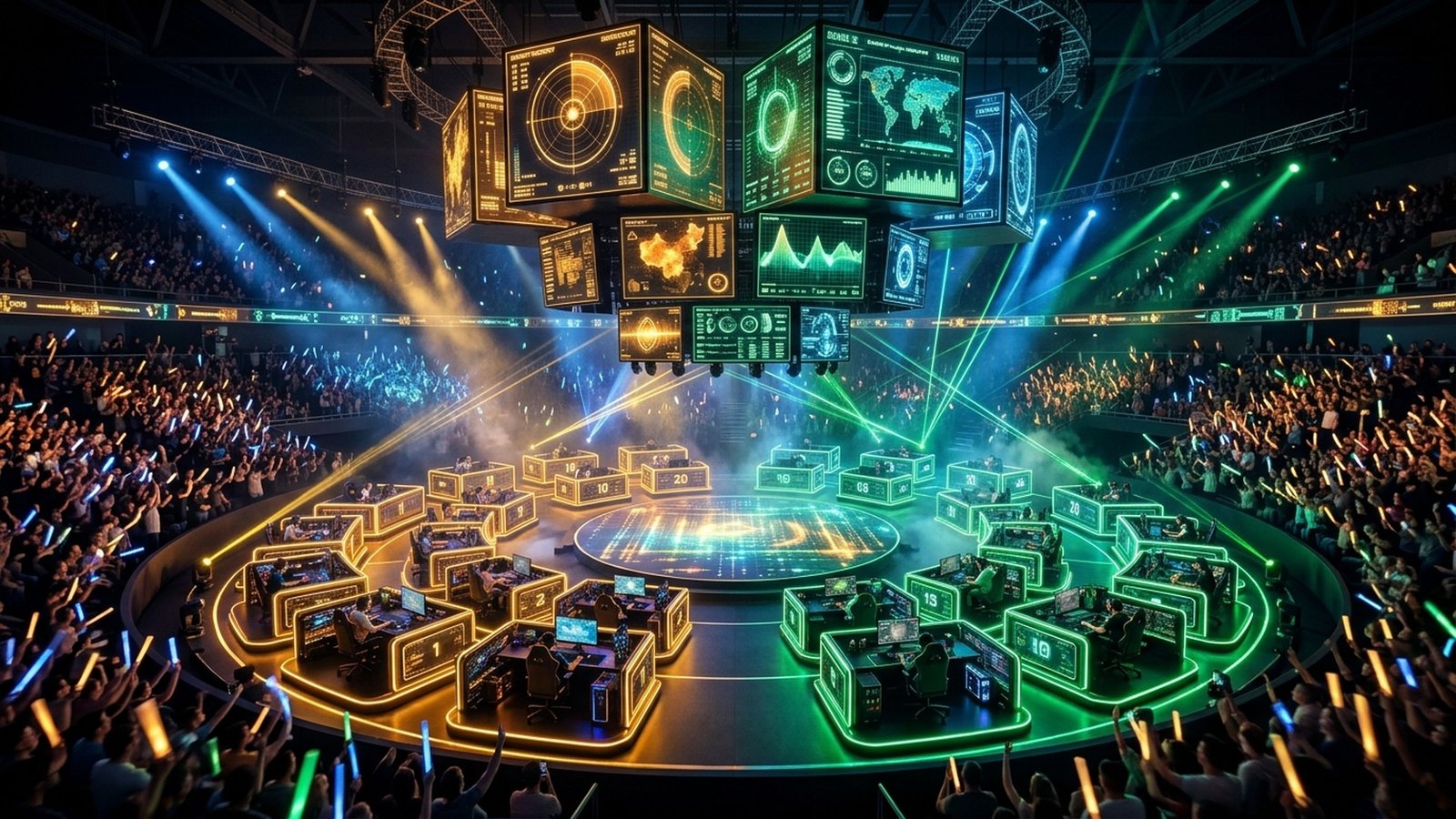
The Apex Legends Global Series (ALGS) Year 5 Pro League has officially launched across North America, EMEA, and APAC North. Following the transformative Season 23 hero balance patch, the competitive Battle Royale landscape has undergone an unprecedented strategic metamorphosis. The era of high-mobility aggressive edge-fighting has collided with a fortified, survival-focused Double Support Bunker Meta, forcing teams to balance beacon scanning with relentless zone rotations.
ALGS Year 5 Pro League Tournament Brief
- Format & Structure: 30 Teams per Region, 3 Groups of 10, Triple Round-Robin across 6 Matchdays
- Championship Target: Top 8 Teams Advance to Split 1 Playoffs LAN ($1,000,000 Prize Pool)
- Map Distribution: Storm Point (3 Games) & World’s Edge (3 Games) per Matchday
- Reigning Champions: Spacestation Gaming (SSG) & Team Falcons (Hal, Genburten, Zer0)
- Meta Defining Comp: Conduit / Newcastle + Wattson / Catalyst + Pathfinder / Valkyrie
Table of Contents: ALGS Year 5 Tactical Breakdown
- 1. Regional Power Tier Rankings: NA & EMEA Superteams
- 2. The Double Support Bunker Meta: Newcastle & Conduit Synergy
- 3. High-Stakes POI Drop Contests: The Wall & Siphon Skirmishes
- 4. Team Falcons Evolution: Zer0’s Micro-Rotations & ImperialHal’s Anchor Play
- 5. Hardware Telemetry: Controller 4-3 Linear vs MNK Rapid Trigger
- 6. Tournament Operations & Cross-Ecosystem Strategic Links
- 7. Frequently Asked Questions (ALGS Schedule, Standings & Rules)
1. Regional Power Tier Rankings: NA & EMEA Superteams
North America continues to reign as the most competitive and financially saturated ALGS theater. The offseason roster shuffle witnessed the solidification of multi-title champions while hungry up-and-coming Challenger Circuit graduates claimed contested drop spots:
2. The Double Support Bunker Meta: Newcastle & Conduit Synergy
The defining tactical shift of ALGS Year 5 is the complete stabilization of the Double Support Composition. In previous years, compositions centered on pure recon and escape tools (Bangalore, Bloodhound, Horizon). However, aggressive ability nerfs and the enhanced utility of Support Class perks—which guarantee mobile respawn beacons and banner crafting at replicators—have changed how early fights are managed.
By pairing Newcastle’s Castle Wall fortified barricades with Conduit’s Radiant Transfer temporary shield regeneration, teams can withstand multi-team third-party crossfires in open-field End Game zones. When an enemy team commits ordnance and grenades, Newcastle’s mobile revive shield allows 100% safe character recoveries while dragging downed teammates behind unbreakable cover.
3. High-Stakes POI Drop Contests: The Wall & Siphon Skirmishes
Under the ALGS POI (Point of Interest) draft system, teams select designated drop spots based on tournament seeding. However, unresolved contested locations remain the flashpoint for early tournament eliminations. On Storm Point, disputes surrounding The Wall and Cascade Falls have resulted in brutal 50/50 off-spawn fighting.
Teams that lose off-spawn contests in Game 1 and Game 2 face insurmountable point deficits, frequently forcing mid-series roster tilt. Successful squads prioritize landing on guaranteed weapon bins, securing fast armor upgrades before committing to 3v3 team wipe brawls.
4. Team Falcons Evolution: Zer0’s Micro-Rotations & ImperialHal’s Anchor Play
Team Falcons—featuring in-game leader Rhys ‘Zer0’ Perry alongside multi-time MVP Philip ‘ImperialHal’ Dosen and Noyan ‘Genburten’ Ozkose—operates as the gold standard of competitive execution. While Zer0 calls micro-rotations through the narrowest chokepoints, ImperialHal has masterfully adapted to the controller anchor position.
Rather than over-extending for solo frags, Hal’s discipline in holding rear angles ensures Falcons are never flanked during Ring 4 consolidations. Their synergy in coordinating focal fire produces instant 3-second knockdowns on isolated opposing scouts.
5. Hardware Telemetry: Controller 4-3 Linear vs MNK Rapid Trigger
The eternal input debate in Apex Legends remains razor-sharp in ALGS Year 5. Over 68% of the North American Pro League lobbies compete on game controllers utilizing the standardized 4-3 Linear (No Deadzone) sensitivity preset. This configuration unlocks unmatched close-range tracking consistency within 15 meters during SMG hip-fire skirmishes.
Conversely, elite Mouse and Keyboard (MNK) pilots have regained strategic ground through magnetic rapid trigger keyboards and Hall-effect switches. Rapid tap-strafing, wall-bouncing, and jitter-aim recoil smoothing allow MNK players to navigate open-field terrain without taking predictable linear damage.
6. Tournament Operations & Cross-Ecosystem Strategic Links
Stay connected with comprehensive esports coverage, tactical setups, and competitive tournament calendars:
- Review competitive tournament circuits and prize pools: Esports World Cup 2027 Club Program Expansion: $70M Prize Pool Breakdown
- Calibrate zero-latency competitive peripherals: Rapid Trigger Hall-Effect Keyboard Tuning & 8000Hz Polling Telemetry
- Explore Counter-Strike Major qualification drama: CS2 Shanghai Major European RMR Opening Telemetry: NAVI vs Spirit Power Rankings
- Track cross-title roster movements: VCT 2026 Americas & EMEA Rostermania Tracker: Sentinels Rebuild & Free Agency
5. Map Macro Strategies: Storm Point Elevation vs World’s Edge Choke Points
Navigating the split map schedule requires vastly different tactical approaches from Pro League coaches. On Storm Point, vast open valleys and dramatic vertical elevation shifts around Lightning Rod and Highpoint favor teams possessing early Valkyrie skyward dives or Pathfinder ziplines. Securing high-ground topography before Ring 3 closes is the single greatest predictor of top-3 matchday placement.
In contrast, World’s Edge remains a labyrinth of lethal choke points around Harvester, Sorting Factory, and Fragment. In this urban terrain, Catalyst’s Dark Veil iron curtain and Wattson’s interception pylon defenses provide impenetrable fortresses against aggressive 3-man pushes. Squads that master both environments will dominate the 6-matchday aggregate standings on the road to the $1,000,000 LAN Finals.
7. Team Communication Protocols & In-Game Leader Call Architecture
In high-intensity 20-team lobbies where six different squads share the same building during final ring collapses, acoustic clarity and communication hierarchy determine championship viability. Championship IGLs like Zer0 and Sweetdreams enforce strict single-voice callout structures, eliminating panic chatter and focusing crosshair priority on single isolated targets.
By standardizing damage callouts—differentiating between flesh damage, broken armor shields, and character ability cooldowns—teammates coordinate instantaneous 3-man pushes that wipe opposing rosters in under four seconds before nearby third-party squads can react.
8. Split 1 Playoffs International LAN Venue & Championship Trophy Stakes
The pinnacle objective of the 6-matchday regular season is securing one of the coveted 40 international seeds for the ALGS Split 1 Playoffs LAN. Scheduled to take place in Tokyo, Japan, the tournament will unite the world’s top battle royale rosters before a sellout crowd of 15,000 passionate esports fans.
- $1,000,000 Championship Purse: The winning squad claims $300,000 alongside guaranteed automatic qualification for the ALGS Year 5 Championship.
- Match Point Grand Finals Format: Once a team breaches the 50-point threshold, they become ‘Match Point Eligible’. The first eligible team to win an outright battle royale game claims the world championship.
- Regional Slot Allocations: North America (12 slots), EMEA (8 slots), APAC North (9 slots), APAC South (7 slots), South America (4 slots).
This grueling competitive structure ensures that every isolated kill point and survival placement secured during weekly regular-season games carries massive downstream ramifications for international esports glory.
Frequently Asked Questions (Competitive & Search Telemetry)
What is the structure and schedule for the ALGS Year 5 Pro League?
The ALGS Year 5 Pro League features 30 elite teams per region divided into three groups of 10. Teams compete in a triple round-robin across six regular-season matchdays. The top 8 teams in the overall standings qualify directly for the Split 1 Playoffs LAN with a $1,000,000 international prize pool.
Why is the Double Support meta so dominant in Year 5?
The combination of Newcastle’s fortified Castle Walls and Conduit’s instantaneous temporary shield regen allows teams to survive intense third-party grenade bombardments and reset downed teammates safely without getting wiped.
Who is favored to win North American ALGS Pro League Split 1?
Team Falcons (featuring ImperialHal, Zer0, and Genburten) and Spacestation Gaming (SSG) are heavy favorites due to their deep zone knowledge, superior 3v3 fighting prowess, and dominant POI control.
Which input is currently preferred by pro players in ALGS?
Approximately 68% of North American Pro League players compete on controller using 4-3 Linear settings for close-range rotational tracking, while remaining Mouse and Keyboard players utilize rapid-trigger keyboards for advanced movement and tap-strafing.
Related posts:
 Fortnite FNCS Competitive Roadmap & Siphon Ranked Update: Peterbot, Pollo, Trios Format & Prize Pool
 CS2 Sub-Tick Architecture & 8000Hz Polling Rate Pro Analytics: Input Latency, KAST% Telemetry & Aim Consistency
 LoL Worlds 2026 Knockout Stage Schedule & Swiss Final Scorecard: Dplus KIA vs BLG, Karmine Corp vs T1, Gen.G vs LYON & Bo5 Fearless Draft Guide
 League of Legends Worlds 2026 Knockout Stage Masterclass: T1 vs Gen.G Macro Telemetry, Faker’s Mid-Lane Roams & Swiss Stage Autopsy