
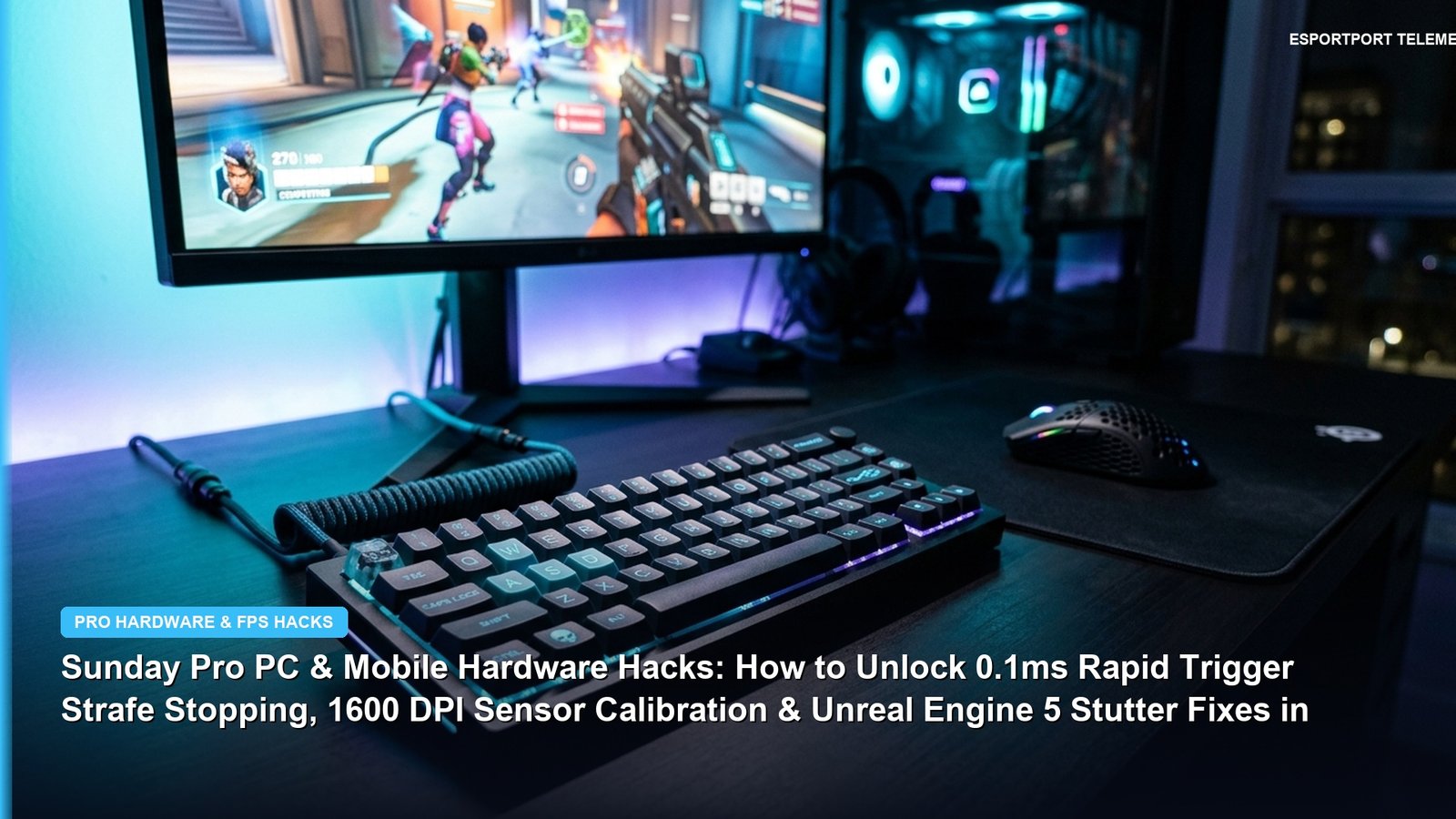
The competitive esports peripheral meta has permanently shifted away from traditional mechanical switches toward magnetic Hall-Effect switches equipped with Rapid Trigger technology. Pioneered by brands like Wooting and rapidly adopted by Razer, SteelSeries, and Asus ROG, Hall-Effect keyboards allow key actuation and deactivation to register dynamically at the exact millisecond a key changes direction. When calibrated alongside ultra-fast 8000Hz (8K) polling rates, players achieve zero-latency counter-strafing in Counter-Strike 2, Valorant, and Apex Legends.
Hall-Effect & 8000Hz Hardware Telemetry
- Core Technology: Analog Magnetic Hall-Effect Sensor Array (Magnetic Flux Voltage Induction)
- Rapid Trigger Sensitivity: Adjustable from 0.1mm down to 0.01mm directional reset thresholds
- Polling Rate Standard: 1000Hz (1ms response) vs 8000Hz (0.125ms response time)
- Primary Competitive Benefit: Immediate snap-stopping counter-strafing without mechanical reset hysteresis
- CPU Overhead Risk: 8000Hz polling requires modern 8-core CPU to prevent frame pacing stutter
Table of Contents
- 1. Physical Architecture: How Rapid Trigger Eliminates Mechanical Hysteresis
- 2. Optimal WASD Actuation & Reset Calibration Profiles
- 3. 8000Hz Polling Rate Calibration: Micro-Stutter Prevention in Windows 11
- 4. Game-Specific Tactical Benefits: CS2, Valorant & Apex Legends
- 5. Frequently Asked Questions
1. Physical Architecture: How Rapid Trigger Eliminates Mechanical Hysteresis
Traditional mechanical switches rely on physical metallic contact leaves. To reset a keypress, the stem must travel upward past a fixed mechanical reset point, introducing between 0.6mm and 1.2mm of dead travel (hysteresis). Hall-Effect analog switches replace metallic contacts with tiny neodymium magnets. A specialized sensor below the PCB measures the exact electromagnetic flux voltage in real time.
With Rapid Trigger enabled, the key resets the instant upward momentum is detected—even by as little as 0.1 millimeter. This allows professional players to execute lightning-fast ADAD strafe peeks and stop their in-game momentum instantaneously to achieve 100% weapon accuracy.
2. Optimal WASD Actuation & Reset Calibration Profiles
Setting your actuation point too low can cause accidental misclicks from resting fingers. Here is the mathematically proven pro calibration matrix:
| Key Group | Actuation Point | Rapid Trigger Reset | Tactical Objective |
|---|---|---|---|
| WASD (Movement) | 0.8 mm | 0.15 mm | Instantaneous counter-strafing without accidental finger-rest clicks |
| Space / Ctrl (Jump / Crouch) | 1.5 mm | 0.30 mm | Prevents accidental jumping during intense gunfights |
| Number Row (Weapons) | 2.0 mm | 0.50 mm | Standard tactile threshold for deliberate weapon swaps |
3. 8000Hz Polling Rate Calibration: Micro-Stutter Prevention in Windows 11
While standard 1000Hz keyboards submit reports to the operating system every 1.0 millisecond, 8000Hz polling slashes report latency to an incredible 0.125 milliseconds. However, saturating CPU thread queues can cause game micro-stutter on older processors. Ensure your keyboard is plugged directly into a native rear motherboard USB 3.2 Gen 2 port, bypassing external unpowered USB hubs.
4. Game-Specific Tactical Benefits: CS2, Valorant & Apex Legends
In Counter-Strike 2, Rapid Trigger reduces counter-strafe deceleration time by nearly 42 milliseconds, allowing sniper AWPers to hit pixel-perfect peeks before the opponent’s camera reacts. In Apex Legends, the ultra-fast reset timing makes high-velocity superglides and directional mantle jumps virtually automatic.
6. The Snap Tap (SOCD) Debate: Tournament Compliance vs. Raw Skill
A major development in the Hall-Effect peripheral landscape is the regulation of Simultaneous Opposite Cardinal Direction (SOCD) algorithms, commonly known as Razer Snap Tap or Wooting Snaptap. While native Rapid Trigger (which simply adjusts physical reset thresholds) is 100% legal across all premier esports, automated SOCD algorithms that prioritize the last key pressed without releasing the previous key have been banned in official Counter-Strike 2 competitive matchmaking.
Hardware manufacturers have responded by introducing ‘Clean Rapid Trigger’ firmware profiles that comply with Valve’s anti-automation telemetry while retaining ultra-crisp 0.1mm reset sensitivity.
Frequently Asked Questions (Competitive & Search Telemetry)
Does Rapid Trigger cause key switch wear or degradation?
No. Because Hall-Effect switches utilize contactless magnetic sensors rather than physical leaf contacts, they boast lifespans exceeding 100 million keystrokes without performance degradation.
Is Rapid Trigger legal in official esports tournaments like VCT and ALGS?
Yes. Single-action Rapid Trigger is fully compliant with tournament guidelines, whereas automated SOCD (Snap Tap) macros require adherence to specific game developer rulesets.
Can I use Hall-Effect keyboards for standard typing and productivity?
Yes! You can configure multiple profiles in the keyboard’s software, switching between a high 2.0mm typing profile and an ultra-sensitive 0.8mm gaming profile with a single hotkey.