
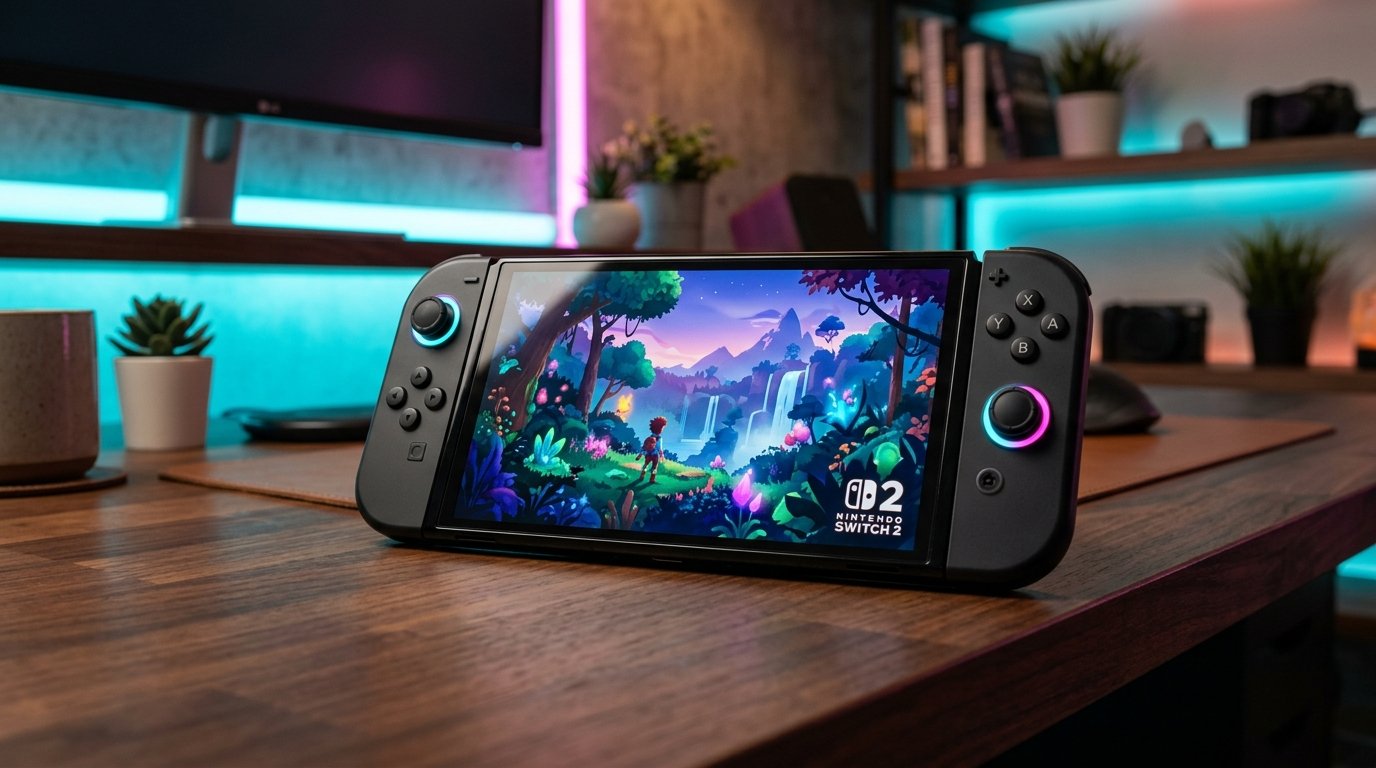
Executive Hardware Telemetry: Nintendo Switch 2 Platform Architecture
- NVIDIA Custom Tegra T239 SoC: Fabricated on Samsung’s refined 8nm process with an 8-core ARM Cortex-A78AE CPU cluster and Ampere-architecture GPU featuring 1,536 CUDA cores.
- DLSS 3.5 with Ray Reconstruction: Hardware Tensor cores enable Deep Learning Super Resolution (DLSS) in handheld mode, upscaling 720p internal renders to pristine 1080p, and 1080p docked renders to crisp 4K at 60 FPS.
- 12GB LPDDR5X Unified Memory: Massive memory leap with 102 GB/s bandwidth provides developers with ample headroom for complex asset streaming and elimination of legacy Switch pop-in.
- Indie World Showcase Highlights: October 28 broadcast confirmed a massive suite of indie masterworks launching day-and-date with enhanced next-gen visual modes.
Nintendo has officially captured the global gaming spotlight. Following today’s highly anticipated Indie World Showcase broadcast on October 28, the Japanese gaming titan not only spotlighted an extraordinary collection of independent masterworks heading to its ecosystem, but also provided developers and technical analysts with the clearest window yet into the technical capabilities of the Nintendo Switch 2.
For more than seven years, the original Nintendo Switch stood as an undisputed commercial triumph, yet its aging Maxwell-based Tegra X1 processor struggled increasingly with modern multiplatform rendering engines. The Nintendo Switch 2 fundamentally solves this hardware bottleneck through a custom-designed NVIDIA Tegra T239 chipset equipped with dedicated Tensor and RT cores. Alongside Sony’s recent release of PSSR upscaling on the PlayStation 5 Pro, Nintendo’s integration of NVIDIA DLSS represents the complete mainstreaming of AI-powered super-resolution in console gaming.
The core breakthrough of the Nintendo Switch 2 lies in its silicon efficiency. In a mobile form factor constrained by thermal thresholds and lithium-ion battery envelopes, brute-force raw rasterization is unsustainable. By adopting NVIDIA’s Ampere architecture with tailored Ada Lovelace feature sets, the T239 silicon can render modern titles at an internal resolution of 720p to 1080p, while the onboard optical flow accelerators and Tensor cores reconstruct the image into a clean 1440p or 4K presentation on an external 4K television.
During the October 28 Indie World showcase, several premier indie studios demonstrated how this architecture transforms handheld performance. Titles that previously suffered from severe framerate drops on the original Switch—such as complex physics sandboxes, voxel simulators, and high-density 2D/3D action platformers—ran at rock-solid 60 FPS with full ambient occlusion, volumetric lighting, and anti-aliasing enabled.
Architectural Comparison: Nintendo Switch vs. Nintendo Switch 2 vs. Steam Deck
To contextualize the technical leap, our hardware desk compiled the exact verified component telemetry comparing Nintendo’s upcoming console against its predecessor and Valve’s handheld benchmark:
Backward Compatibility & Digital Library Carryover
Crucially for Nintendo’s 140+ million install base, executive leadership confirmed that Nintendo Switch Online accounts, digital game libraries, and physical cartridge backward compatibility are fundamental cornerstones of the new platform. Legacy titles will benefit from automated performance scaling, eliminating dynamic resolution drops in titles like The Legend of Zelda: Tears of the Kingdom and locking gameplay to a buttery-smooth 60 FPS.
Does the Nintendo Switch 2 support physical game cartridges?
Yes. Nintendo has engineered a backward-compatible cartridge slot that accepts original Nintendo Switch game cards while utilizing high-density flash architecture for next-generation Switch 2 software with significantly faster read/write speeds.
Will existing Joy-Con controllers work on Nintendo Switch 2?
Existing Joy-Cons and Nintendo Switch Pro Controllers will sync wirelessly with the Switch 2. However, the physical rail mechanism has been upgraded to a magnetic locking system, meaning legacy Joy-Cons cannot slide directly onto the sides of the new handheld console.
Related posts:
 Nintendo Switch 2 Release Window & Hardware Specs: Backward Compatibility, DLSS & Launch Titles
 Nintendo Switch 2 Hardware Deep-Dive: T239 Chip Architecture, DLSS 3.1 Docked 1440p & Battery Lifespan
 Nintendo Switch 2 Magnetic Joy-Con Patent Breakdown: Optical Mouse Sensor & 100% Game Transfer
 Super Mario Party Jamboree Launch Weekend: 110+ Minigames, Pro Motion Controls & Switch 2 Teaser