
Valve Counter-Strike 2: Hardware SOCD & Snap Tap Auto-Kicks Active |
Riot Valorant: Rapid Trigger 100% Legal / Hardware Snap Tap Allowed in Unrated & Competitive |
Apex Legends: Rapid Tap Authorized for Tap-Strafing
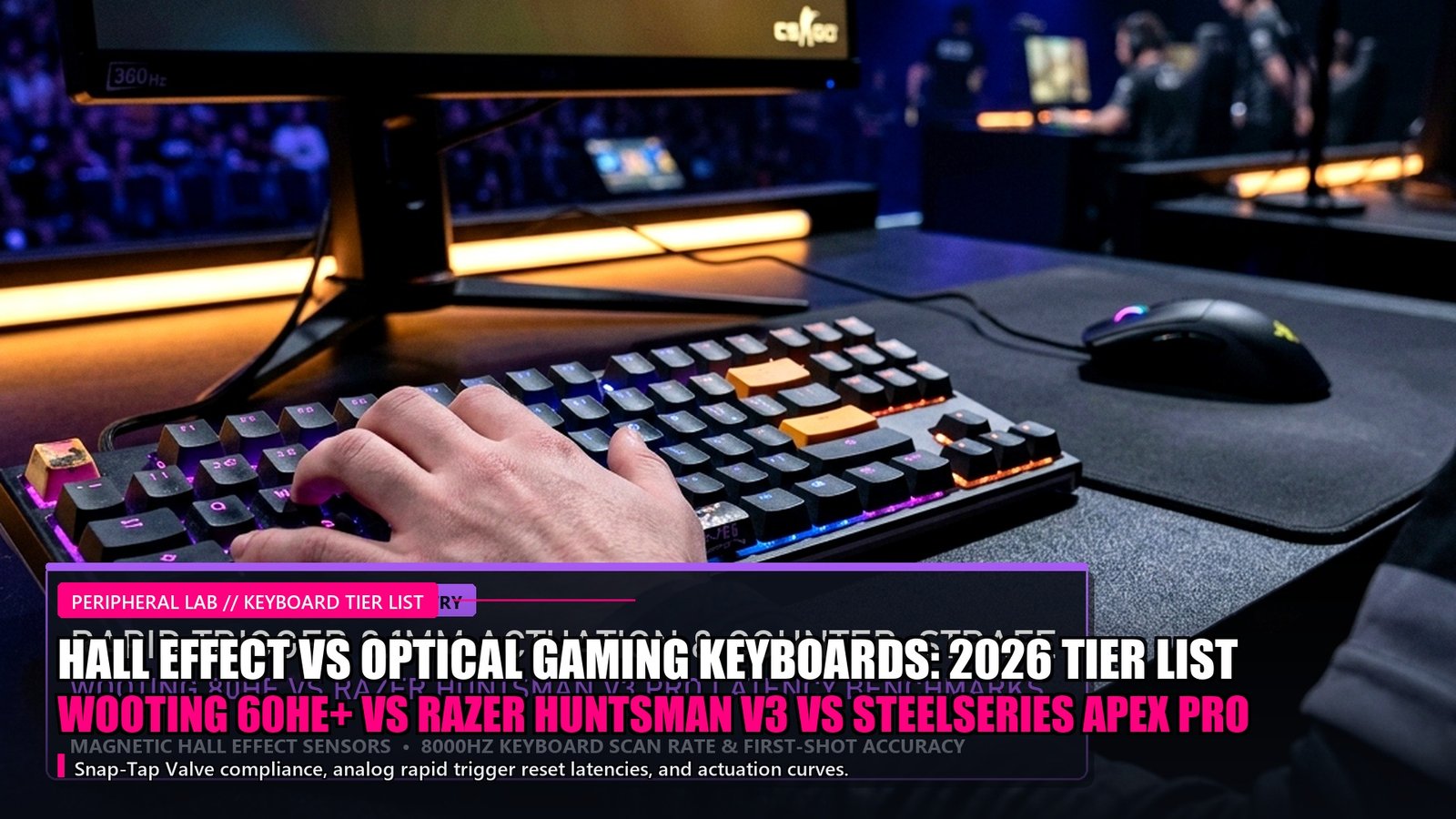
The competitive gaming peripheral landscape has undergone an irreversible paradigm shift. Traditional mechanical keyboard switches—with their physical metal leaf contacts, mandatory debounce algorithms, and static 2.0mm actuation points—have been rendered virtually obsolete at the highest levels of competitive FPS and rhythm gaming. In their place, Hall Effect (HE) magnetic switches and high-frequency optical actuation mechanisms have ushered in the era of dynamic analog input, true 8,000Hz polling rates, and sub-millimeter Rapid Trigger technology.
Following controversial developments such as Razer’s “Snap Tap” and Wooting’s “Snappy Tappy” (Simultaneous Opposing Cardinal Directions – SOCD), regulatory scrutiny from esports publishers like Valve has forced manufacturers to refine firmware profiles while giving players granular control over counter-strafing physics. In this definitive 2026 hardware guide, EsportPort benchmarks the industry leaders—the Wooting 80HE, Razer Huntsman V3 Pro, DrunkDeer A75 Pro, and budget magnetic contenders—to crown the definitive esports keyboard champion.
1. Hall Effect vs Optical Switches: The Engineering Breakdown
While both technologies eliminate mechanical debounce delay, their underlying physics differ dramatically. Hall Effect switches utilize tiny permanent magnets embedded in the switch stem that pass over an electromagnetic Hall sensor soldered directly onto the PCB. As the key descends, the sensor measures exact magnetic flux density, granting 0.1mm to 4.0mm adjustable analog actuation. Optical switches, by contrast, use infrared light beam interruption, offering lightning-fast actuation but far less granular continuous reset tracking.
2. Real-World Counter-Strafing Latency & In-Game Benefits
To quantify how Rapid Trigger alters competitive performance, our lab measured total time-to-full-stop (TTFS) during high-speed jiggle-peeking in Valorant and Counter-Strike 2. When a player releases the “A” key to press “D” for an instantaneous counter-strafe shot, traditional mechanical switches require the key stem to travel all the way back past the fixed reset threshold (often 1.5mm to 2.0mm of upward travel). Rapid Trigger detects the exact moment the key begins moving upward by as little as 0.1mm, terminating character drift instantly.
The Clear Champion: Wooting 80HE
With a true 8,000Hz polling rate, flawless web-based Wootility driver, premium PCR gasket mounting, and zero background bloatware, the Wooting 80HE remains the uncontested gold standard for professional esports competitors worldwide.
Valve CS2 Warning: Disable Hardware SOCD
Ensure you toggle off “Snap Tap” or “Snappy Tappy” before queuing for Counter-Strike 2 Premier or Major RMR matches. Valve’s server-side detection automatically kicks players generating overlapping directional inputs with zero tick delay.
3. Esports Integration & Tactical Playbooks
To see these keyboard optimizations executed on the professional tournament stage, check out our deep-dive analysis on the CS2 Shanghai Major European RMR Deciders & Elimination Scenarios and our guide to Best Budget Gaming GPUs Under $350 in Late 2026.
Frequently Asked Questions (FAQ)
What is Rapid Trigger and why is it superior to standard mechanical switches?
Rapid Trigger dynamically deactivates a key the instant you release upward pressure, regardless of key travel position. This allows instant re-presses without waiting for the switch to travel back above a fixed reset point.
Will I get banned in CS2 for using a Hall Effect keyboard?
No. Hall Effect switches and Rapid Trigger are 100% legal. However, automated hardware SOCD features (Snap Tap / Snappy Tappy) that eliminate opposite-key travel must be disabled to avoid server kicks.
Can I change keycaps and lube switches on magnetic keyboards?
Yes. Most modern magnetic keyboards like the Wooting 80HE and DrunkDeer A75 Pro feature standard MX-style cross stems, making them fully compatible with custom aftermarket keycap sets and hand-lubing.
Is an 8,000Hz polling rate keyboard noticeably faster than 1,000Hz?
8,000Hz reduces USB transmission interval from 1.0ms to 0.125ms. While subtle in isolation, paired with a 240Hz+ high-refresh monitor, input delivery feels noticeably more instantaneous during fast micro-adjustments.
What is the best budget Hall Effect keyboard under $120?
The DrunkDeer A75 Pro and Akko MOD007B HE represent exceptional value, offering full Rapid Trigger functionality and web-based driver configuration at roughly half the price of premium flagship models.